Antigua seen from the Cerro de la Cruz with the Volcán de Agua behind the town
Guatemala · Sacatepéquez

Antigua Guatemala

A Spanish capital abandoned to earthquakes in 1773 and never quite emptied: cobbled streets, ruined convents, three volcanoes at the end of every block, and the best base in Central America for a night on a mountain watching another one erupt.

Photo: Saulo Zayas via Pexels
Overview

The city the volcanoes kept

Antigua sits at 1,530 metres in a valley hemmed by three volcanoes: Agua, the perfect cone to the south; Acatenango to the west; and Fuego beside it, which erupts a dozen times a day and glows red after dark. The Spanish ruled Central America from here for two centuries, until the 1773 quake flattened the churches and the capital moved to Guatemala City. What stayed is a UNESCO-listed grid of single-storey houses in ochre and terracotta, roofless baroque churches, and a pace of life set by church bells and the morning market.

It is small. You can cross it on foot in 20 minutes, and most of what matters is within six blocks of the Parque Central. The rest of the valley, the coffee farms, the villages and the trailheads, is a short chicken-bus or tuk-tuk ride away.

Three days covers the town and a volcano. A week adds Lake Atitlán, the Chichicastenango market and a second volcano. Semana Santa needs a bed booked months ahead and a different kind of patience.

The Volcán de Fuego erupting at sunset above Antigua
The gridParque Central, the cathedral, La Merced, the arch, the ruins, the cafés and the market. Everything on foot.
The volcanoesAcatenango and Fuego to the west, Agua to the south, Pacaya an hour away: the reason to carry boots.
The valleyCoffee fincas, Ciudad Vieja, San Juan del Obispo and the hill villages, all within 30 minutes.
Further outLake Atitlán and its villages, Chichicastenango's market, the Pacific coast at Monterrico.
Highlights

What to see first

Nine places. The town takes a day and a half; the rest are the trips that make the stay.

The arcades of the Palace of the Captains General in Antigua
UNESCO · Centre

Parque Central & the arch

The fountain square under the cathedral façade and the arcaded Palace of the Captains General, where the colony was governed. Three blocks north, the Santa Catalina arch frames the Volcán de Agua on 5a Avenida, the most photographed view in the country. Go at seven, before the tuk-tuks.

Parque Central in detail →
A white statue on the façade of La Merced church
Churches · Ruins

La Merced and the ruins

The yellow-and-white La Merced, still in use, has the largest fountain in Central America in its cloister. Then the ruins: the roofless nave of San Francisco, the Capuchinas convent with its circular tower of cells, Santa Clara's arcaded courtyard, and the cathedral's own crypts behind the rebuilt front.

La Merced & the ruins in detail →
A volcano erupting at dusk with an ash cloud
The big one

Acatenango & Fuego

The overnight climb to a camp at 3,600 metres on Acatenango, facing Fuego across a saddle, is the trip people cross continents for. Lava fountains after dark, a summit at dawn, and the whole chain of volcanoes from Tajumulco to El Salvador in the first light. Details in the volcano section below.

Acatenango in detail →
Lake Atitlán with volcanoes on the far shore
Day trip · Overnight

Lake Atitlán

A caldera lake 95 kilometres west, ringed by three volcanoes and a dozen Maya villages reached by boat: Panajachel for the pier and the shops, San Juan La Laguna for weaving cooperatives, San Marcos for yoga, Santiago for the Tz'utujil market. A long day trip; better as two nights.

Lake Atitlán guide →
Market tents filling a plaza in the Guatemalan highlands
Thursday & Sunday

Chichicastenango

The largest market in Central America fills the hill town of Chichi twice a week: textiles, masks, flowers, candles and incense on the steps of Santo Tomás church, where Maya rituals and Catholic mass share the same stairs. Two and a half hours each way; shuttles leave Antigua before dawn.

Chichicastenango in detail →
A farmer picking ripe coffee cherries
Coffee

The fincas

Antigua coffee is one of the great origins, grown on the volcanic slopes around the valley. Finca Filadelfia runs the most complete tour, from nursery to roaster, with a tasting; La Azotea in Jocotenango pairs its farm with a music museum; smaller farms on the Agua slopes take visitors by arrangement. Harvest runs December to March.

The fincas in detail →
The church of San Juan del Obispo under the Volcán de Agua
Villages

San Juan del Obispo & Ciudad Vieja

Ten minutes up the Agua slope, San Juan del Obispo has the first bishop's palace in Central America, a convent that sells its own chocolate, and a view back over the whole valley. Ciudad Vieja, below it, is the first Spanish capital, buried by a mudflow from Agua in 1541 and rebuilt around its church.

The villages in detail →
Clouds drifting over hills and water
Viewpoint

Cerro de la Cruz

Twenty minutes up a paved path from the north end of town to a stone cross with the whole grid laid out below and Agua filling the sky behind it. Best at eight in the morning, when the volcano is clear, or at sunset. Tourist police walk the path; go in daylight.

Cerro de la Cruz in detail →
A stall of colourful traditional Guatemalan sweets
Market · Craft

The markets and the sweets

The municipal market by the bus terminal is where the valley shops: fruit, flowers, comedores serving pepián at plastic tables. The artisan market beside it sells textiles and jade. Doña María Gordillo's sweet shop on 4a Calle Oriente has sold candied fruit and milk sweets since 1872; the queue is part of it.

Markets & sweets in detail →

Also worth your time

Holy Week

Semana Santa

Palm Sunday to Easter Sunday · 21–28 March in 2027

The largest Holy Week celebration in the Americas: processions of hooded cucuruchos carrying floats of carved saints over alfombras, carpets of dyed sawdust, flowers and pine needles laid on the streets through the night and destroyed within hours. Lent processions run every Sunday from Ash Wednesday. Book accommodation eight months ahead.

Hotel · Museum

Casa Santo Domingo

3a Calle Oriente · museums daily

A 1640s monastery turned hotel, with the ruined church lit by candles, crypts with original frescoes, and six museums of colonial and pre-Columbian art in the grounds. Walk in for a coffee and the gardens even if you are sleeping elsewhere.

Chocolate

ChocoMuseo and the cacao workshops

4a Calle Oriente · daily

Guatemala is where the Maya drank cacao first. The museum is free and the two-hour bean-to-bar workshop ends with your own bar; the Fernando's Kaffee shop does a quieter version with better chocolate.

Hill villages

Hobbitenango and Earth Lodge

40 minutes above town, San Mateo Milpas Altas

Two hillside eco-parks on the ridge north of the valley: Hobbitenango's hobbit houses and the famous rope swing over the drop, Earth Lodge's avocado farm, treehouses and a deck that looks straight at the three volcanoes. Sunset, then a shuttle down.

Hikes & nature

Four volcanoes and a lake

Guatemala has 37 volcanoes and the best of them stand around this valley. Every climb here is with a guide: the trails are unmarked, the weather turns fast, and the agencies in town run the camps, the porters and the police escorts that make the mountains safe.

JFMAMJJASOND

Climbing season: teal = dry and clear, green = shoulder, grey = rainy season (treks run, afternoons cloud over and the camp gets wet).

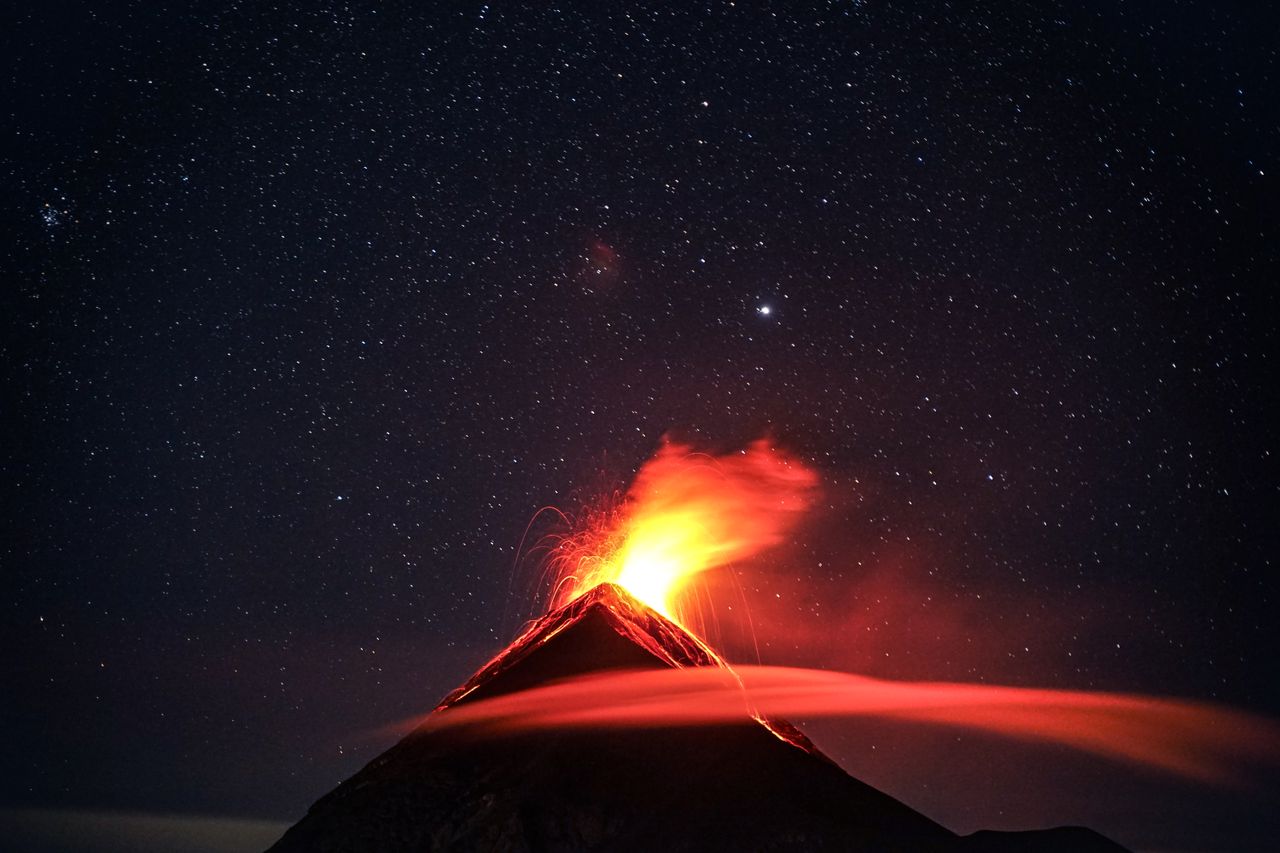
Lava erupting from a volcano at night
Demanding

Acatenango overnight

The one that justifies the flight. From La Soledad at 2,400 metres the trail climbs through farmland, cloud forest and pine to a camp on Acatenango's shoulder at around 3,600 metres, directly across a saddle from Fuego. Through the evening Fuego erupts every 15 to 30 minutes, throwing lava a few hundred metres into the dark. At four the next morning you climb the last 400 metres of scree to the 3,976-metre summit for sunrise over the whole volcanic chain, then descend by late morning.

Full route guide →
2 dayscamp at 3,600 m
1,600 mascent
3,976 msummit

Steep, cold and worth it. Agencies supply tents, meals and warm gear; carry four litres of water, a headtorch and every layer you own. The optional evening walk to the Fuego ridge gets you within a kilometre of the crater and is only sensible on a quiet day.

Glowing lava in a volcanic crater
Moderate

Pacaya

The easy volcano, 90 minutes south-east, and the one for a half day. From San Francisco de Sales a wide trail climbs through forest to the lava fields below the 2,552-metre cone, where the ground is warm, the 2021 flows are still black and glassy, and guides toast marshmallows in the vents. The summit itself is closed; the view across the valley to Agua and Fuego is the point.

Full route guide →
6 kmreturn
3 hwalking
500 mascent

Morning and sunset tours both run; sunset is better for the glow. Horses are offered at the gate for anyone struggling with the altitude.

A hiker with a Guatemalan flag on a summit
Demanding

Volcán de Agua

The perfect cone that sits at the end of every Antigua street. The trail starts at Santa María de Jesús, on the slope above town, and climbs steadily through fields and forest to the 3,760-metre crater rim, where there is a chapel and a view that takes in Antigua, the lake and the Pacific on a clear day. Dormant, so no lava, and a much quieter mountain than Acatenango.

Full route guide →
14 kmreturn
7–9 hwalking
1,700 mascent

Go with a guide and the tourist-police escort the agencies arrange; robberies on this trail are a known problem. Start before dawn to summit before the cloud.

Dusk over Lake Atitlán and its volcanoes
Moderate

Indian Nose and the Atitlán volcanoes

From the lake villages, a pre-dawn climb up the Indian Nose ridge above San Juan La Laguna gives the sunrise over all three lake volcanoes, with Fuego smoking on the horizon, in under two hours. San Pedro volcano, 3,020 metres, is the full morning version through coffee and cloud forest. Both are run by village guide cooperatives.

Indian Nose guide → San Pedro guide →
4–8 kmreturn
2–5 hwalking
300–1,400 mascent

Stay a night on the lake to do either. The boat timetable sets the day: last public lanchas leave Panajachel around five.

Easy · 40 min

Cerro de la Cruz

North end of 1a Avenida

The town viewpoint. Paved path, benches, the whole grid and Agua. Daylight hours only.

Full route guide →
Easy · half day

Finca walks and the Agua foothills

Ciudad Vieja, San Juan del Obispo, Santa María

Lanes through coffee and macadamia between the villages on the Agua slope, with the volcano above and the valley below. Tuk-tuk out, walk between them, bus back.

Full route guide →
Birds

Finca El Pilar and the quetzal reserves

Above Antigua; Chelemhá and the Biotopo del Quetzal further north

El Pilar's cloud-forest trails ten minutes from town have hummingbirds and motmots. The resplendent quetzal needs a trip north to Alta Verapaz, best from February to May.

Full route guide →
Good food

Pepián, chocolate and the valley's coffee

Guatemalan cooking is Maya at the root, Spanish at the edges: thick stews of toasted seeds and chillies, corn in every form, black beans, and cacao that was currency here before it was dessert. Antigua adds the country's best dining rooms and a serious café culture.

A bowl of stew served with a tortilla
Eat this

Pepián, kak'ik and jocón

Pepián is the national dish: chicken or beef in a dark sauce of toasted pumpkin seeds, sesame, chillies and charred tomato, with rice and tortillas. Kak'ik is the Q'eqchi' turkey soup, red with achiote; jocón the green version with tomatillo and coriander. Find all three at the comedores in the market and at the typical kitchens below.

Traditional Guatemalan sweets being prepared
Eat this

Street and sweet

Rellenitos, plantain stuffed with sweet black beans, fried; chuchitos and tamales wrapped in corn husk and banana leaf; tostadas with guacamole and salsa from the carts on the park; shucos, the Guatemalan hot dog, after dark. The dulces típicos of candied figs, coconut and milk fudge come from the 1872 sweet shop on 4a Calle.

A coffee farmer with harvested cherries
Drink this

Coffee and cacao

Antigua is a coffee origin in its own right, and the cafés pour it properly: Fernando's Kaffee roasts in-house, 12 Onzas and Artista de Café do the filter and espresso flights, El Gran Café the cheap good cup. Hot chocolate the old way, water and cacao and chilli, is at the cacao workshops and the convent shop in San Juan del Obispo.

Fine dining

The classic

Mesón Panza Verde

5a Avenida Sur · dinner, book

The country's most decorated dining room, in a boutique hotel with a candlelit cellar and a garden terrace: Guatemalan produce in a European frame, a long wine list and live jazz some nights. The place for the one dressed-up dinner.

Q350–600 · $$$
In the ruins

El Refectorio, Casa Santo Domingo

3a Calle Oriente · lunch and dinner

The hotel's main restaurant inside the monastery walls, with the candlelit ruins as the dining room and a menu that moves between Guatemalan classics and the international hotel standard. Book a table by the arches.

Q300–550 · $$$
Tasting menu

Angeline

2a Avenida Norte · dinner, book

A small room with a short, changing tasting menu of Guatemalan ingredients cooked with real technique: hoja santa, native chillies, lake fish, cacao. The town's most ambitious kitchen and its hardest table.

Q450–700 · $$$$

Where locals eat

Typical

La Cuevita de los Urquizú

2a Calle Oriente · lunch and dinner

Clay pots of pepián, jocón, hilachas and kak'ik on the counter; you point, they ladle. The most reliable plate of traditional food in town.

Q60–110 · $
Typical

Rincón Típico

3a Avenida Sur · lunch

Grilled chicken and pork from the charcoal pit, with rice, beans, salad and tortillas, for a few quetzales more than the market. Packed with locals by one.

Q40–80 · $
Market

The comedores at the mercado

Municipal market, by the bus terminal · breakfast and lunch

Desayuno chapín of eggs, beans, plantain and cream before eight; pepián and caldo at noon. Pick the stall with the longest queue of market women.

Q25–50 · $
Brunch

Fermento

6a Avenida Norte · breakfast to late afternoon

An open kitchen doing sourdough, ferments, eggs and the best brunch in town, with a courtyard. The expat favourite for a reason.

Q80–150 · $$
Vegetarian

El Comalote

4a Calle Poniente · lunch and dinner

Guatemalan food cooked meat-free and well: pepián de vegetales, chiles rellenos, blue-corn tortillas, horchata.

Q60–110 · $
Café

Fernando's Kaffee & 12 Onzas

7a Avenida Norte; 3a Calle Poniente · mornings

Fernando roasts the beans and makes the chocolate in the back; 12 Onzas pours the most careful cup in town. Breakfast at either sets the day up.

Q25–70 · $
Nightlife

Mezcal, salsa and an early curfew

Antigua's bars close around one by municipal rule, which concentrates the evening. What there is runs on mezcal and rum, rooftops with volcano views, live music and one famously tiny back room.

Institution

Café No Sé

1a Avenida Sur · evenings

A candlelit warren of rooms with a mezcal bar at the back you enter through a fridge door, live music most nights and a crowd of writers, guides and people who meant to leave Antigua years ago. The one bar everyone ends up in.

Cocktails

Ulew

3a Calle Poniente · evenings

A cocktail bar behind an unmarked colonial door, built around Guatemalan ingredients: cacao, cardamom, local rums, Quetzalteca aguardiente. The grown-up drink in town.

Rooftops

Café Sky, Antigua Brewing Company & the terrace bars

1a Avenida Sur; 7a Avenida Norte · sunset

Rooftop terraces for the hour when Agua turns pink: Café Sky for the view and the happy hour, Antigua Brewing for its own ales with Fuego smoking on the skyline. Go early for the rail.

Dancing

Las Vibras, La Sin Ventura & Lucky Rabbit

Around 5a Avenida Sur · late

Las Vibras for salsa and reggaeton on a packed floor, La Sin Ventura for salsa nights and a speakeasy feel, Lucky Rabbit's four bars and pool table for the hostel crowd. All done by one.

Practical notes

Before you go

Getting there

Fly to Guatemala City's La Aurora airport; Antigua is 45 kilometres and one to two hours away by shuttle, which every hotel arranges for around US$15–25. Chicken buses are cheaper and slower. From the Mexican or Honduran borders, shuttle services run direct.

Getting around

On foot in town; the cobbles punish wheels and heels. Tuk-tuks for the villages and the Cerro, chicken buses from the terminal for the valley, tourist shuttles for the lake, Chichi and the volcanoes. Guided climbs include transport.

Seasons

  • Nov–Apr: dry season, clear mornings, cold nights on the volcanoes; busiest at Christmas and Holy Week.
  • May–Oct: rain most afternoons, green hills, fewer people; mornings still usually clear.
  • Semana Santa: the week before Easter, unforgettable and full.

Altitude and safety

Town is at 1,530 metres and the volcano camps around 3,600; give yourself two nights before Acatenango. Walk with others after dark, keep phones out of sight on the Cerro and the Agua trail, and use the agencies for every climb.

Money

The quetzal; roughly Q7.7 to the US dollar. ATMs on the park, cards in most restaurants, cash for markets, tuk-tuks and comedores. Tip guides and porters on the volcanoes; they carry your tent.

Spanish schools

Antigua is the Spanish-school capital of the Americas: one-to-one lessons from about US$150 a week, homestays with local families for a little more. Many visitors come for a week of lessons and stay a month.

Photography

Photo credits

Photographs on this page are by independent photographers published on Pexels under the free Pexels licence. Click a title to open the original.

Powered by Webloyt | Report abuse