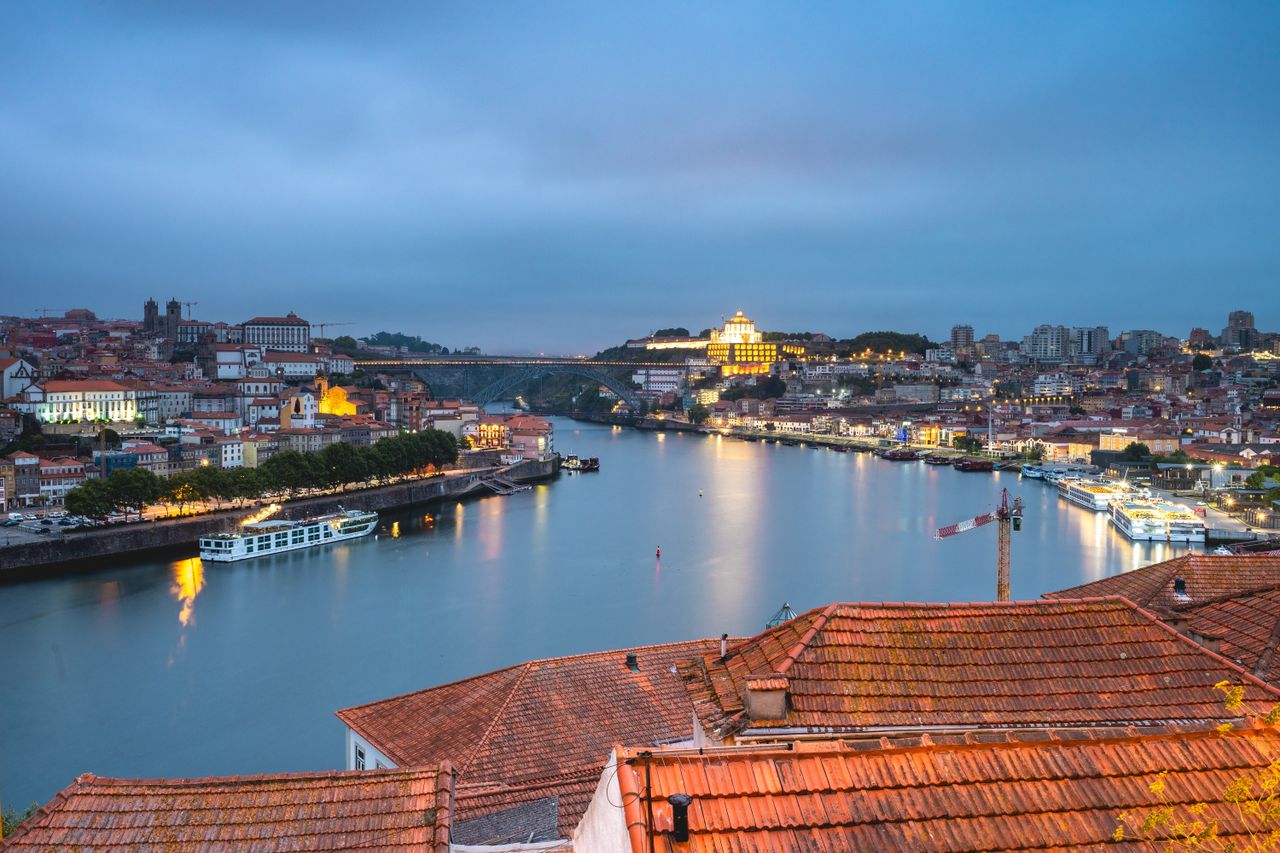
Porto and the Dom Luís I bridge over the Douro at sunset
Portugal · The north

Porto

A granite city stacked up a river gorge, with wine lodges on one bank, tiled churches on the other and the Atlantic at the end of the road. Hard-working, plain-spoken and very good at dinner.

Photo: Matej Simko via Pexels
Overview

Two cities and a river

Porto climbs the north bank of the Douro from the Ribeira quay to the cathedral, a tangle of alleys, iron balconies and blue-and-white azulejo façades that UNESCO listed in 1996. Across the water, Vila Nova de Gaia is where the port wine has been aged for three centuries, in long lodges with the shippers' names painted on the roofs.

The Dom Luís I bridge, a double-decked iron arch from 1886, joins them: trams and walkers on the top deck, 45 metres up, cars and more walkers below. Everything you came for is within a 30-minute walk of its ends, and the Atlantic beaches of Foz are a vintage tram ride west.

Three days covers the city, the lodges and a long lunch. A fourth for the Douro valley by train. A fifth if you want the walkways of the Paiva or the granite wilds of the Gerês.

A street vendor on the Ribeira with the Dom Luís I bridge behind
Ribeira & SéThe riverside quay, the cathedral hill, the old alleys between them. Where the city began.
Baixa & BolhãoAliados avenue, Clérigos tower, Lello, the market and the Galerias de Paris bars: the working centre.
GaiaThe port lodges, the cable car, the WOW district and the best view of Porto, which is from across the river.
Foz & MatosinhosTram 1 to the beaches, the Felgueiras lighthouse, Serralves, and the grilled-fish street of Matosinhos.
Highlights

What to see first

Nine places, all walkable or a short tram from the centre. Porto is steep; plan the day downhill where you can.

The double-deck Dom Luís I bridge with autumn trees
UNESCO · River

Ribeira & the Dom Luís I bridge

The quay of tall, narrow houses and café terraces, the rabelo boats moored below, and the bridge's upper deck for the view down the gorge. Cross it on foot at dusk and come back by the lower deck, when the lodges are lit.

Ribeira and the bridge in detail →
Early morning on the Douro with rabelo boats and Porto behind
Wine · Gaia

The port lodges

Taylor's, Graham's, Ramos Pinto, Cálem, Ferreira and a dozen more line the Gaia bank, each with cellar tours and tastings in rooms of cobwebbed barrels. Climb to the Jardim do Morro or the Serra do Pilar monastery for the postcard view back at Porto.

The port lodges in detail →
The Clérigos tower against a blue sky
Baroque · View

Clérigos tower & Livraria Lello

The 76-metre granite bell tower of 1763 has 225 steps and the best view in the centre. Round the corner, the neo-Gothic Lello bookshop of 1906, with its crimson staircase and stained-glass roof, now takes a timed ticket that is refunded against a book.

Clérigos and Lello in detail →
The clock and tiled hall of São Bento station
Azulejos

São Bento station

Twenty thousand blue-and-white tiles cover the entrance hall of the railway station, painted by Jorge Colaço in 1905–16 with battles, royal weddings and the grape harvest. Free, central, and the best introduction to the art form on the way to everywhere.

São Bento in detail →
The azulejo-covered side wall of the Igreja do Carmo
Churches

The tiled churches

The Carmo's side wall, Santo Ildefonso's façade above Batalha square, the Congregados by São Bento and the Capela das Almas on Santa Catarina, all sheathed in azulejos. Inside the Igreja de São Francisco, by contrast, 300 kilograms of gold leaf cover the baroque woodwork.

The tiled churches in detail →
A warrior statue overlooking the rooftops of Porto
Cathedral · Old town

The Sé & the cathedral hill

A fortress-church of the 12th century on the highest point of the old town, with a tiled Gothic cloister and a terrace over the roofs. The alleys below it, the Barredo, are the oldest in the city, and the Miradouro da Vitória across the valley looks back at all of it.

The Sé in detail →
The Felgueiras lighthouse at Foz do Douro at sunset
Sea · Tram

Foz do Douro

Tram 1 rattles along the river from the Ribeira to the mouth, where the Felgueiras lighthouse takes the Atlantic on the chin in winter and the Pérgola promenade fills with evening walkers in summer. Gardens, beach cafés and the Castelo do Queijo at the far end.

Foz to Matosinhos on foot →
Porto city hall at the top of Aliados avenue
Market · Centre

Aliados & Bolhão market

The grand avenue of banks and belle-époque façades runs up to the city hall; two streets east, the Mercado do Bolhão, rebuilt in 2022, sells the north's cheese, bread, fish and flowers in an iron-and-glass hall with counters for a glass and a plate.

Aliados and Bolhão in detail →
An old warrior statue in Porto
Art · Architecture

Serralves & Casa da Música

Serralves is an art-deco villa, an 18-hectare park and Álvaro Siza's contemporary art museum, all in one estate out toward Foz. Rem Koolhaas's angular Casa da Música, on the Boavista roundabout, runs tours and concerts most days. Porto's modern side, both worth an afternoon.

Serralves and Casa da Música in detail →
Walks & nature

Boardwalks, granite and the sea

Porto's own walks are seafront and riverside. Within two hours are the most spectacular boardwalk in Europe and Portugal's only national park.

A steep railed wooden walkway
Moderate

Passadiços do Paiva & the 516 Arouca bridge

Eight and a half kilometres of wooden walkway bolted to the gorge of the Paiva river, an hour south-east of Porto near Arouca. It climbs and drops over quartzite ridges, passes the Aguieiras waterfall and river beaches, and crosses the 516 Arouca, a 516-metre pedestrian suspension bridge 175 metres above the water. Tickets are timed and limited; book online before you go.

Full route guide →
8.7 kmone way
3–4 hwalking
Many stairseffort

Start at Areinho and walk to Espiunca, or the reverse; taxis shuttle between the ends. Bring water and a hat: there is little shade and the stair sections are steep.

A moss-covered abandoned village in the Peneda-Gerês
Moderate

Peneda-Gerês National Park

Portugal's only national park, 90 minutes north: granite mountains, oak forest, wild Garrano ponies, long-horned cattle and the espigueiros, stone granaries on stilts, of villages like Soajo and Lindoso. The classic day is the Trilho da Preguiça from Vila do Gerês or the Pedra Bela viewpoint and the Arado waterfall; the Sete Lagoas swimming holes are the summer reward.

Full route guide →
8–14 kmday loops
3–5 hwalking
300–600 mascent

A car makes it easy; day tours from Porto cover the viewpoints. Snow is possible in winter, and the river pools are cold until July.

A lighthouse on a pier at sunset
Easy

Foz to Matosinhos along the sea

From the Felgueiras lighthouse at the river mouth, follow the Atlantic promenade north past the Castelo do Queijo, the beaches of Molhe and Matosinhos and Siza's tide pools at Leça da Palmeira, finishing at the Casa de Chá da Boa Nova on its rocks. Fishermen, surfers and the grilled-sardine smoke of Matosinhos' Rua Heróis de França on the way.

Full route guide →
7 kmone way
2 hwalking
Flateffort

Tram 1 from the Ribeira to Foz is the way out; the metro from Matosinhos is the way back. Sunset from the breakwater is the city's best free show.

A bridge over the Douro river at Peso da Régua
Easy

The Douro by train, and a walk in the vines

The Linha do Douro from São Bento follows the river east for two hours to Peso da Régua and Pinhão, hugging the water through the terraced vineyards of the Alto Douro, a UNESCO landscape. From Pinhão, walk up through the Quinta do Bomfim or along the river road to Casal de Loivos for the view the postcards use, then take a rabelo boat or the train back.

Full route guide →
6–10 kmvineyard walks
2–3 hwalking
200–400 mascent

Harvest is late September; the vines turn red in October. Pinhão station's tiled panels are worth the stop even if you walk nowhere.

Birds

Douro estuary reserve

Afurada, Gaia side of the river mouth

Sandbanks and marsh where the river meets the sea, with egrets, kingfishers, spoonbills and waders on migration. A boardwalk, a hide, and the fishing village of Afurada's grills next door.

Garden

Jardins do Palácio de Cristal

Massarelos · all day

Terraced gardens above the river with peacocks, roosters and the best sunset benches in the city. Walk down through the Virtudes garden to the Ribeira.

Riverbank

Gaia to Afurada riverside

Cais de Gaia westward

Four flat kilometres from the lodges to Afurada under the Arrábida bridge, with the city across the water the whole way. Lunch at the grills, ferry back to Porto.

Route guide →
Good food

Tripe, francesinha and a few serious tables

Porto's nickname, tripeiros, comes from the 15th century, when the city gave its meat to the fleet and kept the offal. It still cooks like a port: big, salty, generous. In the last decade it has also become the most interesting restaurant city in Portugal.

A francesinha sandwich with fries
Eat this

Francesinha

Steak, ham, fresh and cured sausage between bread, under melted cheese, a fried egg and a spiced beer-and-tomato sauce, with chips to mop it. Invented in the 1950s and argued about ever since. One per visit is plenty; Café Santiago and Cervejaria Brasão are the usual arbiters.

A Portuguese custard tart on paper
Eat this

Pastéis de nata, bifanas, cachorrinhos

Custard tarts warm from Manteigaria on Rua de Alexandre Braga; a bifana, pork simmered in garlic and wine on a roll, at Conga since 1976; the cachorrinho, a pressed hot dog with spicy sauce and a cold beer, at Gazela by the Batalha. Porto's snacks are a meal in themselves.

Portuguese pastries and a drink on a table
Eat this

Tripas, bacalhau and the sea

Tripas à moda do Porto, white beans and tripe stewed with sausage, is the city's dish; bacalhau à Gomes de Sá, salt cod with potato, egg and olive, is the north's. Then the Atlantic: grilled sardines and sea bass in Matosinhos, octopus rice, and the percebes that cost what they cost.

Fine dining

The top table

Antiqvvm

Rua de Entre-Quintas, above the Palácio de Cristal gardens · dinner

Vítor Matos's dining room in a 19th-century villa over the river, with Portuguese produce in a long, precise tasting menu. The city's top table.

€160–220 · $$$$
Wine cellar

The Yeatman

Gaia, in the hotel above the lodges · dinner

Ricardo Costa's kitchen, with Porto in the windows and a cellar of Portuguese wine that runs to a thousand labels. Book the terrace table for sunset.

€190–260 · $$$$
On the rocks

Casa de Chá da Boa Nova

Leça da Palmeira, on the rocks · lunch and dinner

Rui Paula's seafood menu in Álvaro Siza's 1963 tea house, with the waves breaking under the window. The best lunch in the north; a 20-minute taxi from the centre.

€180–240 · $$$$
Counter

Euskalduna Studio

Rua de Santo Ildefonso · dinner, 16 seats

Vasco Coelho Santos cooking at a counter for a handful of guests, Basque discipline on Portuguese ingredients. Hard to book and worth the trouble.

€150–200 · $$$$
Foz

Pedro Lemos

Foz do Douro · lunch and dinner

A stone house in Foz with a rooftop terrace and a tasting menu led by the day's fish and the chef's garden. The quiet one.

€120–180 · $$$

Bib Gourmand

Bib Gourmand

Pátio 44

Passeio de São Lázaro, Bonfim · lunch and dinner

Traditional northern cooking done with care in a quiet square east of the centre: bacalhau, slow-cooked meats, proper desserts, a short Douro list. The city's own Bib.

€25–40 · $$
Bib Gourmand

OMA

Baião, in the Douro, an hour east · lunch and dinner

A countryside dining room on the river road toward the valley, cooking Minho and Douro produce at country prices. Pair it with the Douro train day; Baião has a station on the line.

€30–45 · $$

Tascas and counters

Institution

Casa Guedes

Praça dos Poveiros · all day

The roast pork sandwich with runny Serra cheese that the whole city queues for, eaten standing with a glass of vinho verde.

€5–12 · $
Tasca

Taberna dos Mercadores

Rua dos Mercadores, Ribeira · lunch and dinner, book

Twenty seats in a stone room off the quay, octopus rice and grilled fish cooked in sight. The Ribeira tasca that deserves its reputation.

€25–45 · $$
Tasca

Adega São Nicolau

Rua de São Nicolau, Ribeira · lunch and dinner

Bacalhau, tripas, grilled meats and house wine from the barrel in an alley behind the quay. Old-school and reliably good.

€20–40 · $$
Market

Mercado do Bolhão

Rua Formosa · mornings to mid-afternoon, closed Sunday

Counters for oysters, cheese, charcuterie and a glass of wine inside the rebuilt market. Buy a picnic for the Douro train upstairs.

€10–30 · $
Grills

Rua Heróis de França, Matosinhos

Matosinhos · lunch

A street of fish restaurants grilling sardines, sea bream and squid on the pavement. Pick the one with the longest local queue; the fish came off the boats that morning.

€20–40 · $$
Café

Majestic & Guarany

Rua de Santa Catarina; Aliados · all day

Belle-époque cafés of 1921 and 1933, mirrors and leather, for a coffee and a nata between the sights. The Majestic charges for the room; the Guarany is the locals' choice.

€5–15 · $
Wine

Port, and the river that makes it

Port is fortified Douro wine, aged across the river in Gaia since the 1700s because the city had the cool, damp cellars and the ships. The table wines of the same valley are now as good a reason to come.

A row of wine glasses on a table

How to taste the lodges

Pick two or three, not six. Taylor's for the grand tour and the garden; Graham's for the view and the aged tawnies; Ramos Pinto for the belle-époque offices and the art; Ferreira for the history of the only great house that was always Portuguese; Cálem or Sandeman for the quick, cheerful version. Most tours run 45–60 minutes with three to five glasses, from about €20 to well over €100 for the vintage flights, and the serious houses need booking.

Learn the styles first. Ruby is young, fruity and bottled early; tawny is aged in wood, nutty and amber, labelled 10, 20, 30 or 40 years; white port with tonic is the city's summer drink; vintage is one exceptional year, bottled unfiltered and kept for decades. The WOW district next to the lodges adds a wine museum and a dozen restaurants if you want a whole day.

The classic

Taylor's

Rua do Choupelo, Gaia · daily, book online

A self-guided museum tour through the lodges, then a tasting on the terrace with the city below. The Chip Dry white and the 20-year tawny are the ones to compare.

€20–60 · $$
The view

Graham's

Rua do Agro, high on the Gaia hill · daily, book

The 1890 lodge with the best terrace of all and the Vinum restaurant attached. Tastings run from the standard flight to flights of 1960s vintages.

€25–150 · $$$
Portuguese house

Ferreira

Avenida Ramos Pinto, Gaia · daily

Dona Antónia Ferreira built the Douro's great quintas in the 19th century; the tour tells her story through the cellars. Good tawnies at fair prices.

€18–40 · $$
Wine bar

Prova & Capela Incomum

Rua Ferreira Borges; Travessa do Carmo

Prova pours Douro reds, Bairrada sparkling and old tawnies by the glass with knowledgeable staff; Capela Incomum does the same in a deconsecrated chapel. The two best places to drink Portuguese wine without a tour.

€5–15 a glass · $$
Day in the valley

Quinta do Bomfim, Quinta da Roêda, Quinta do Tedo

Pinhão, by train · tastings and lunch

Walk from Pinhão station to Bomfim (Dow's) for a vineyard walk and a tasting on the veranda; Roêda (Croft) for the terraces; Tedo for a small, organic estate with lunch. A rabelo boat runs between them in season.

€15–60 · $$
What to drink

Beyond port

Any good list

Douro reds from Touriga Nacional and old field blends; Vinho Verde from the Minho, light and faintly fizzy, with Alvarinho the serious version; Bairrada's Baga and sparkling wines. Ask for a Douro branco with the fish and a 10-year tawny with the cheese.

€4–10 a glass · $
Aerial view of a terraced vineyard
Alto Douro

The terraces

Schist walls built by hand over three centuries hold the vines on slopes too steep for anything else. UNESCO-listed since 2001; prettiest at harvest and in late October.

A glass of wine beside a plate of food
At the table

Pairing the city

Francesinha wants a cold beer. Bacalhau wants a Douro white or an Alvarinho. Tripas want a young Douro red. Port is for after, with queijo da Serra, or before, white and iced, on a terrace.

Nightlife

Galerias de Paris and the late streets

Porto goes out late and on foot. Dinner at nine, bars from eleven, and by one in the morning two streets in the Baixa are a single open-air party. Clubs open at midnight and matter from two.

The strip

Rua Galeria de Paris & Rua Cândido dos Reis

Baixa, below Clérigos · Thursday to Saturday from 11pm

Two parallel streets of bars in old warehouses and galleries, with the crowd on the cobbles between them. Plano B for the art-space club with two dance floors, Porto Tónico for the cheap gin and tonic, Galeria de Paris for the bric-a-brac bar, The Gin House for the cocktail. Start here and let the night decide.

Cultural

Maus Hábitos

Rua de Passos Manuel, fourth floor · evenings, concerts and club nights

A rooftop art space with a vegetarian restaurant, exhibitions, live bands and electronic nights, in a 1930s garage building. The most interesting room in the city and the one locals send you to.

Classic bars

Café Candelabro, Casa do Livro & Aduela

Rua da Conceição; Rua Galeria de Paris; Rua das Oliveiras

Candelabro is a bookshop-bar with wine and a crowd of journalists; Casa do Livro a wood-panelled former bookshop with DJs on weekends; Aduela a terrace bar for the hours before the Galerias fill. All within three minutes of each other.

Clubs and music

Passos Manuel, Pérola Negra & the riverside

Baixa and Ribeira · late

Passos Manuel, in the old Coliseu cinema foyer, for indie and electronic; Pérola Negra, a former cabaret, for the late dance floor; the Ribeira's riverside bars for a drink by the water that end earlier than the Baixa. Fado, which is a Lisbon art, has a Porto home at Casa da Mariquinhas on Rua de São Sebastião, with dinner and a show.

The São João night, 23 June, is the biggest party of the year: the whole city in the streets with plastic hammers, grilled sardines, fireworks over the river at midnight and hot-air balloons at dawn. Book a bed months ahead.
Practical notes

Before you go

Getting there

Francisco Sá Carneiro airport is 25 minutes from the centre on metro line E, with flights from most European cities. Trains from Lisbon take about three hours to Campanhã, then a short hop to São Bento.

Getting around

The old town is walkable but steep; the Guindais funicular and the Gaia cable car save knees. An Andante card covers metro, bus and the suburban trains. Tram 1 to Foz and tram 22 through the Baixa are heritage lines and worth the fare. Taxis and ride apps are cheap.

Seasons

  • May–Jun and Sep–Oct: warm, clear, the Douro at its best.
  • Jul–Aug: hot in the city, busy, cool at the beach.
  • Nov–Mar: rain comes in from the Atlantic; the city is quiet and the lodges are empty.
  • 23 June: São João; everything is full.

Booking

The starred restaurants and Euskalduna need weeks; the good tascas a day or two. Lello, the Paiva walkways and the main lodges sell timed tickets online. The Douro train is cheap and fills in summer; buy the day before at São Bento.

Costs

Porto is still the best-value big city in western Europe: a tasca lunch for €12–20, a glass of good wine for €4, a lodge tasting for €20. The stars and the vintage ports are where the money goes.

Where to stay

The Baixa for walking everywhere and the nightlife; the Ribeira for the view and the noise; Cedofeita for galleries and quieter streets; Gaia for the lodges and the morning light on the city; Foz for the sea.

Photography

Photo credits

Photographs on this page are by independent photographers published on Pexels under the free Pexels licence. Click a title to open the original.

Powered by Webloyt | Report abuse