Aerial view of Tower Bridge and the Thames at sunset
England · The Thames

London

Two thousand years of city along a tidal river: a Norman fortress and a Gothic abbey, free museums that would be the pride of any country, a market under the railway arches, deer in a royal park at the end of the Tube, six three-star tables, a thousand pubs and, an hour away by train, white cliffs and vineyards on chalk. This is the guide for walking it.

Photo: Nicole Rathmayr via Pexels
Overview

A city best taken on foot, with a train ticket for the edges

London is nine million people in thirty-two boroughs and a square mile of Roman and medieval city at the centre, strung along a river that still rises and falls seven metres twice a day. The Romans founded it, the Normans fortified it, the Great Fire of 1666 rebuilt it in Wren's stone, the Victorians gave it its railways, museums and parks, and the last thirty years have added a skyline of glass to the east. It is a city of villages rather than one centre, which is why first-time visitors exhaust themselves trying to see it all and why the best days are spent in two or three neighbourhoods, walking.

The things that make London cheap are the things that make it great: the national museums are free, the parks are vast and open from dawn, the riverside is a public path from Hampton Court to the sea, and the Tube and buses run on a tap of a bank card with a daily cap. The things that make it expensive are hotels, the big paid monuments and the restaurants at the top, so this guide is as much about where to spend as where to go. Since 2025 most visitors need an Electronic Travel Authorisation before they fly; the details are in the practical notes, with this year's fares.

Three days covers the Tower, Westminster, one or two museums, the South Bank at dusk, Borough Market and a night in Soho. Five adds Greenwich by boat, Richmond's deer or Hampstead Heath, Kew and a serious dinner. A week lets you take the train out: to the Seven Sisters cliffs, Box Hill and a vineyard, or the Chilterns, and still come back for a pub by the river.

Red double-decker buses crossing Westminster Bridge below Big Ben
Westminster and the CityParliament, the Abbey and Whitehall at one end; St Paul's, the Tower and the Roman wall at the other, with the museums of Bloomsbury between.
The riverThe South Bank from the London Eye to Tower Bridge, Borough Market, the boats to Greenwich and the towpath upstream to Richmond, Kew and Hampton Court.
The villagesSoho and Covent Garden for the night, Notting Hill and Camden for markets, Shoreditch, Dalston and Peckham for bars, Hampstead and Richmond for air.
An hour outThe Seven Sisters cliffs, Box Hill and the Surrey Hills, the Chilterns, the vineyards of Kent and Sussex, all by train from the London termini.
Highlights

What to see first

Nine places for a first visit. Book the paid ones online for a timed slot and arrive at opening; the free museums ask for a booked slot at busy times but rarely turn anyone away. Prices are 2026 adult rates.

The stone walls and turrets of the Tower of London
£37 · Book a slot · Crown Jewels first

The Tower of London

William the Conqueror's White Tower of 1078 at the heart of a fortress that has been palace, mint, menagerie, prison and place of execution, and is still home to the Crown Jewels and the ravens. Go straight to the Jewel House at opening, nine on most days, ten on Sundays and Mondays, or in the last hour and a half, when the queue for the crowns disappears; then take the free Yeoman Warder tour, which is the best hour of storytelling in London. Allow three hours. Tower Bridge next door has its own glass-floored walkway and engine rooms.

The Tower in detail →
The twin Gothic towers of Westminster Abbey
Abbey about £31 · Mon–Sat · Sunday for services

Westminster Abbey and Parliament

The coronation church since 1066 and the burial place of seventeen monarchs, Newton, Darwin, Dickens and the Unknown Warrior; the Lady Chapel's fan vaulting and Poets' Corner are the reasons to pay, and Evensong is the reason to come back free. Across the square, the Houses of Parliament run guided and audio tours on most Saturdays and in parliamentary recesses, and anyone can queue to watch a debate from the public galleries when the Commons is sitting. Big Ben's tower is open to UK residents only. Book the Abbey online and go at opening.

Westminster in detail →
The Millennium footbridge leading across the Thames towards St Paul's
Free · 4 km · Dusk

The South Bank and Tate Modern

The best free walk in the city: from Westminster Bridge past the London Eye, the concrete halls of the Southbank Centre, the book market under Waterloo Bridge, the Globe and Tate Modern, over the Millennium Bridge to St Paul's or on under London Bridge to Borough Market and Tower Bridge. Tate Modern is free and its tenth-floor terrace is the view of St Paul's that everyone photographs. Start an hour before sunset and finish with a drink on the river; the whole stretch is lit, busy and safe after dark.

The South Bank walk →
The dome of St Paul's Cathedral against the sky
£27 · Climb the dome · Free at Evensong

St Paul's Cathedral

Wren's masterpiece, finished in 1710 after the Great Fire, with the second-largest cathedral dome in the world and the three galleries inside it: the Whispering Gallery, where a murmur carries round the wall, the Stone Gallery outside, and 528 steps up the Golden Gallery for the finest view of the river. The crypt holds Nelson, Wellington and Wren himself. The ticket covers everything; come for a service, Evensong at five on most days, and the floor is free.

St Paul's in detail →
The blue whale skeleton hanging in the main hall of the Natural History Museum
Free · Book a slot at weekends

The free museums

The British Museum holds the Rosetta Stone, the Parthenon sculptures and the Sutton Hoo treasure, and until 11 July 2027 the Bayeux Tapestry, in Britain for the first time in nine centuries; the tapestry tickets, £27 to £33, sell out months ahead in phases. The National Gallery's Sainsbury Wing reopened in 2025 with the early Renaissance rehung. In South Kensington the Natural History Museum's blue whale and the V&A's seven miles of galleries stand side by side, and the V&A's new East Storehouse in Stratford opens the stores to anyone. All free, all open daily.

The museums in detail →
Cooks working huge pans of food at a stall in Borough Market
Tue–Sat full market · London Bridge

Borough Market

A thousand years of market under the railway arches at London Bridge, now the city's larder: raclette scraped onto potatoes, oysters, Spanish ham, Ethiopian stews, Kappacasein's toasties, Monmouth coffee and Neal's Yard cheese, with Southwark Cathedral's tower above. Weekday mornings are calm, Saturday is a crush, and Monday is reduced. Eat standing, then walk the arches south to Maltby Street on a weekend for the smaller, better version. Details in the food section.

Borough Market in detail →
Greenwich Park and the Queen's House with the Canary Wharf towers behind
By boat from Westminster · Observatory closed to summer 2027

Greenwich

Take the Thames Clipper down past the Tower and Canary Wharf to the maritime heart of the empire: Wren's Royal Naval College, the Cutty Sark tea clipper, £22, the free National Maritime Museum and the Queen's House, and the climb through Greenwich Park to the Observatory on the hill. The Observatory itself, with the Meridian line in its courtyard, closed in November 2026 for a two-year rebuild and is due to reopen in stages from summer 2027; the view from the hill, the park and the Sunday market are unaffected. The DLR to Cutty Sark is the quick way back.

Greenwich in detail →
The Victorian glass of the Palm House at Kew Gardens
£20–22 · District line · Christmas at Kew from mid-Nov

Kew Gardens

Three hundred acres of botanic garden on the Thames, a World Heritage Site since 2003: the 1848 Palm House, the Temperate House, the treetop walkway, a Japanese gateway, Kew Palace and fifty thousand living plants. Spring brings the bluebells and magnolias, autumn the colour in the arboretum, and from mid-November to early January the illuminated trail of Christmas at Kew, on a separate ticket. Book online, which is cheaper than the gate, and pair it with the towpath walk to Richmond.

Kew in detail →
A guardsman in a red tunic and bearskin marching at Buckingham Palace
State Rooms in summer · £33 · Guard change free

Buckingham Palace and the royal parks

The State Rooms open to the public for ten weeks each summer, in 2026 from early July to late September, for £33 with a timed ticket; the rest of the year the palace is a facade behind railings and the show is the Changing of the Guard, free, on scheduled mornings at eleven. Around it lie the royal parks that make central London bearable: St James's with its pelicans, Green Park, and Hyde Park and Kensington Gardens, where the Serpentine, the Albert Memorial and the parakeets fill an afternoon.

The palace and parks in detail →

Also worth your time

Opens 28 November 2026 · Free

London Museum, Smithfield

The old meat market by Farringdon · Elizabeth line

The former Museum of London reopens in the Victorian market halls of Smithfield with the city's own story, from Roman Londinium to the present, in the most anticipated opening of the year. Permanent galleries are free.

A train from Waterloo or Euston

Hampton Court and the Harry Potter studios

35 min to Hampton Court; 20 min to Watford Junction plus shuttle

Henry VIII's palace with its Tudor kitchens, maze and riverside gardens is the best day out by train, and the end of the Thames Path walk below. The Warner Bros. studio tour at Leavesden, £56 to £59, timed and online only, is the other, for anyone travelling with a Potter reader.

Free, booked · City

The free views

Sky Garden at 20 Fenchurch Street; Horizon 22 at 22 Bishopsgate

Two skyscraper decks let you up for nothing with a ticket booked weeks ahead: the Sky Garden's palm-filled top floors and Horizon 22, the highest free viewpoint in Europe. The View from The Shard charges above £30 for a few more metres. Go at sunset.

Weekend mornings

The street markets

Columbia Road Sun; Portobello Sat; Broadway Market Sat; Camden daily

Columbia Road's flower market, in bloom from eight on Sundays; Portobello Road's antiques on Saturday under Notting Hill's painted terraces; Broadway Market in Hackney for food and the canal; and Camden Lock, crowded and fun, by the Regent's Canal.

Walks & nature

Heath, royal park and towpath inside the city, chalk cliffs and downs an hour out

London has more green space than any capital of its size and a public footpath along its whole river, and the walking country of southern England begins at the end of a fifty-minute train. Nothing here needs boots or a map beyond a phone, and every walk ends at a pub.

JFMAMJJASOND

Walking season: teal = the best weeks, late April to June for bluebells and chalk-grassland flowers and September to October for colour and the deer rut; green = fine, with long light in July and August and short, often muddy days in winter; grey = December, when it is dark by four.

A path beside a wooden fence through autumn woodland
Easy · 6–8 km · Northern line or Overground

Hampstead Heath to Parliament Hill and Kenwood

Three hundred and twenty hectares of heath, old woodland and bathing ponds on the hills above north London, wilder than any other open space in the city. From Hampstead station walk down through the village and up onto the Heath, climb Parliament Hill for its protected view of the City, St Paul's and the Shard, drop past the ponds and climb again to Kenwood House, a free Georgian mansion with a Vermeer and a late Rembrandt self-portrait and a good café, then back through the woods to Hampstead's pubs. Two to three hours with stops. On a hot day, swim in a pond on the way; see the water section.

6–8 kmloop
2–3 hwith Kenwood
98 mParliament Hill

The Holly Bush and the Spaniards Inn are the pubs. Go on a weekday or early on a weekend; the Heath is London's back garden and Sunday afternoon is busy.

Full route guide →
Two red deer stags locking antlers in autumn woodland
Easy · 11.7 km · From Richmond station

The Richmond Park loop

The largest of the royal parks, 955 hectares of grassland, ancient oaks and bracken enclosed by Charles I in 1637 and now a national nature reserve with about six hundred red and fallow deer. The Tamsin Trail runs round the whole perimeter, flat and surfaced, in two and a half to three hours; cut through the middle for King Henry's Mound, with its telescope view of St Paul's ten miles away, the Isabella Plantation's azaleas in late April and May, and Pembroke Lodge's tea rooms on the ridge. The deer are everywhere and are wild: fifty metres away, no feeding, dogs on leads in the rut and the birthing season.

11.7 kmTamsin Trail
2.5–3 hplus stops
Octpeak of the rut

Richmond is twenty-five minutes from Waterloo or on the District line; walk up Richmond Hill for the view of the Thames bend that Turner painted, into the park at Richmond Gate. Bushy Park, next to Hampton Court, has the same deer and a quarter of the people.

Full route guide →
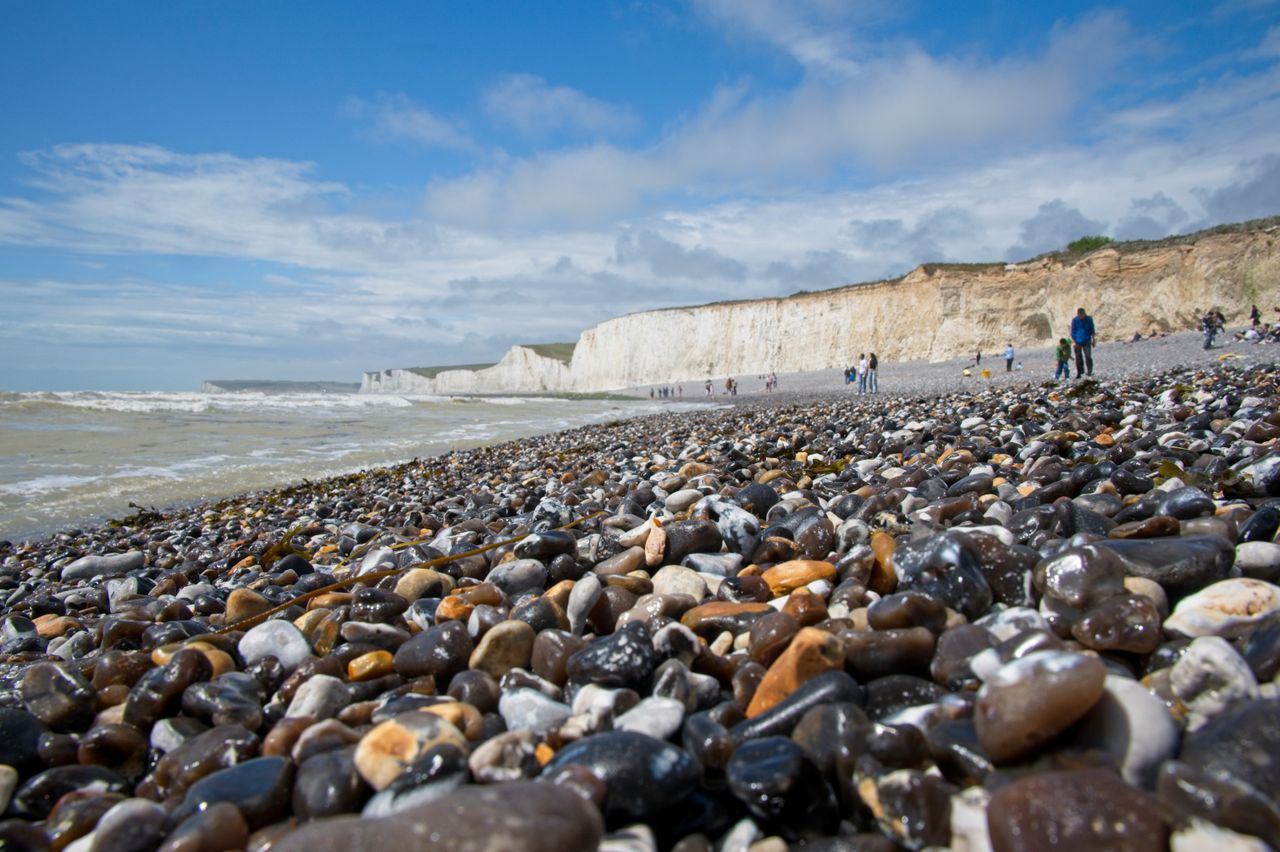
A pebble beach below white chalk cliffs on the English coast
Moderate · 22 km · Victoria to Seaford, back from Eastbourne

The Seven Sisters: Seaford to Eastbourne

The great day walk from London. Train from Victoria to Seaford, under ninety minutes with a change at Lewes, then east along the South Downs Way: over Seaford Head to the view of the cliffs across Cuckmere Haven, through the river's meanders, and up and down the seven chalk sisters in turn, each summit a hundred metres above the Channel, to the National Trust café at Birling Gap, the old Belle Tout lighthouse and the 162-metre drop of Beachy Head before the descent into Eastbourne and a direct train home. Nothing is technical; the climbs are short and repeated and the wind is constant.

22 kmSeaford to Eastbourne
5–6 hwalking
162 mBeachy Head

Buy an off-peak day return to Eastbourne and a Lewes to Seaford single, or separate singles; railcards take a third off. Stay away from the cliff edge, which falls into the sea every winter. The half-day version ends at Birling Gap and takes the bus to Eastbourne.

Full route guide →
Flat · 19 km

Thames Path, Richmond to Hampton Court

4–5 h · train back from Hampton Court to Waterloo

The towpath upriver past Petersham Meadows, Ham House, Teddington Lock, where the tide stops, and Kingston, ending at the gates of Henry VIII's palace. Shorten it at Kingston, 13 km. Downstream, Greenwich to the Thames Barrier is a gritty 6 km of working river.

Route guide →
Flat · 4 km

Regent's Canal, Little Venice to Camden

About 1 h · continue to King's Cross for 3 km more

The towpath from the narrowboats of Little Venice along the edge of Regent's Park, past the zoo's aviary and the Snowdon-era architecture, to the market at Camden Lock. A waterbus runs the same stretch in summer. Easy, pretty and a good first morning.

Route guide →
Moderate · 6–8 km · 50 min by train

Box Hill and the Surrey Hills

Waterloo or Victoria to Box Hill & Westhumble

Across the River Mole on stepping stones, steeply up to the Salomons Memorial view over the Weald, along the chalk to Juniper Top and down through the yews. Two to three hours; Denbies vineyard at the foot of the hill for lunch and a tasting.

Route guide →
Easy · 10–12 km · Overground

Epping Forest

From Chingford station

Two and a half thousand hectares of ancient pollarded beech and hornbeam on the north-east edge: Queen Elizabeth's Hunting Lodge, Connaught Water and the pub at High Beach in a loop. Bluebells in late April, fungi in October.

Route guide →
Moderate · 10 km · 55 min from Marylebone

The Chilterns from Wendover

Chiltern Railways · Coombe Hill and the Ridgeway

Up through beechwoods to the monument on Coombe Hill and its view across the Vale of Aylesbury, along the edge of the Chequers estate and back by the Ridgeway, with red kites overhead the whole way. Three hours and a pub in Wendover.

Route guide →
Long distance · In sections

The Capital Ring and the London Loop

126 km inner circle; 240 km outer circle · every section starts and ends at a station

Two signed circular trails for people who want to see the London nobody visits. Best Ring sections: the Parkland Walk from Highgate, and Oxleas Wood from Woolwich. Best Loop: Farthing Downs from Coulsdon and the Epping edge from Chingford.

Route guide →
Trains out of London are cheapest off-peak, after about half past nine on weekdays and all weekend, and a Two Together or 16–25 Railcard pays for itself in a day. Check the engineering works before a Sunday walk: the lines to the Sussex coast and Surrey are often replaced by buses.
Water

Ponds on the Heath, a lido in Hyde Park and paddleboards on the canal

Londoners swim outdoors all year, in ponds fed by springs and in Victorian lidos, and the canals and the upper Thames are quiet enough to paddle. The tidal river through the centre is for boats only.

Swans on a lake at sunset
Open-water swimming · All yearBest May to September

The Hampstead Heath ponds

Three bathing ponds on the Heath, dug as reservoirs in the eighteenth century and swum in ever since: the Men's and the Ladies' ponds open every day of the year, lifeguarded, with their own fierce communities of regulars who break the ice in January; the Mixed pond opens from about May to September. The water is dark, deep and cold, with coots and herons at the edges and the city nowhere in sight. Entry is about £5 a swim, with a cheaper concession, and summer sessions must be booked online. Parliament Hill Lido nearby is a 61-metre unheated steel-lined pool from 1938, about £9 for a summer morning swim and half that in winter.

About £5per swim
All yearMen's and Ladies'; Mixed May–Sep
4–20°Cwater across the year
Hampstead HeathOverground, Mildmay line

Bring a towel and a tolerance for the cold; there are changing huts and little else. The Serpentine Lido in Hyde Park opens to the public from June to September for a few pounds a session, and Brockwell, Tooting Bec and the heated London Fields lido are the other outdoor pools worth the trip.

Paddleboard and kayak

The canals and the upper Thames

Paddington Basin, King's Cross, Limehouse and Kew Bridge · guided or hire

Operators run paddleboard and canoe sessions on the Regent's Canal from Paddington, King's Cross and Limehouse Basin, and guided paddles on the non-tidal Thames from Kew. Electric picnic boats for up to eight can be hired by the hour at Paddington and King's Cross.

Rowing boats · Easter to October

The Serpentine and Regent's Park

About £15 per adult for half an hour to an hour

Rowing and pedal boats on the Serpentine in Hyde Park and the boating lake in Regent's Park, a London afternoon since the Victorians. Herons watch from the islands.

By boat

The river as transport

Uber Boat by Thames Clippers · tap in with a bank card

The fast commuter boats run from Putney to Greenwich and Woolwich and are the best way to see the city from the water: Westminster to Greenwich takes about an hour and costs less than a tour. Sit outside at the back.

Wildlife

Deer, falcons on the chimneys, green parakeets and a city of foxes

For a city this size London is unusually alive: wild deer in two royal parks, peregrines nesting on power stations and galleries, wetlands on the old reservoirs with bitterns in winter, and parakeets and foxes everywhere. Most of it is a Tube ride away and most of it is free.

The deer of Richmond and Bushy parks

Richmond and Hampton Court · rut September to November, peak October

About six hundred red and fallow deer roam Richmond Park and another three hundred Bushy Park, descendants of the herds kept for royal hunting since the Stuarts. In the autumn rut the red stags roar at dawn and dusk and clash antlers in the bracken; in June the hinds hide calves in the long grass. The Royal Parks ask for fifty metres' distance, no feeding, no touching and dogs on leads in both seasons; photographers who creep closer get charged every year. Dawn in October, from Richmond Gate, is the morning to choose.

JFMAMJJASOND

Wetlands on the reservoirs

Walthamstow Wetlands, free; London Wetland Centre, Barnes, paid · November to March for birds

Walthamstow Wetlands, by Tottenham Hale station, is the largest urban wetland in Europe, ten working reservoirs with herons, cormorants, great white egrets and rafts of wintering duck, open free every day. The Wildfowl and Wetlands Trust's London Wetland Centre at Barnes is the made version, forty hectares of reedbed and lagoon with bitterns in winter, sand martins in summer, water voles and otters, for a ticket of about £20. Woodberry Wetlands in Stoke Newington and the RSPB's Rainham Marshes on the Thames estuary are the other two.

JFMAMJJASOND

Peregrines and parakeets

Tate Modern's chimney, Battersea Power Station, Charing Cross; every park in west London

Peregrine falcons, the fastest animals on earth, nest on London's tall buildings and hunt pigeons over the river; watch points with volunteers and telescopes run outside Tate Modern in summer. Ring-necked parakeets, descended from escaped pets, are now the loudest birds in Kensington Gardens, Hyde Park, Kew and Richmond, bright green and bold enough to land on an outstretched hand by the Italian Gardens.

JFMAMJJASOND

Foxes, seals and beavers

Any street at dusk; the estuary; Enfield and Ealing by arrangement

Red foxes live in every borough and will cross your path on the walk back from the pub. Harbour and grey seals haul out in the outer Thames estuary, counted every year by the Zoological Society, and one occasionally appears under a central bridge. Beavers returned to London in 2022, in a fenced enclosure at Forty Hall in Enfield, and a family released at Paradise Fields in Ealing in 2023 has bred and built dams credited with keeping the neighbourhood dry in the floods of 2024 and 2025. Visits are by organised event only.

JFMAMJJASOND
A deer standing among autumn trees
October

The rut

Dawn, Richmond Gate, fifty metres.

A green rose-ringed parakeet perched on a branch
Kensington Gardens

Parakeets

Escaped, thriving, loud.

A grey heron standing in a wetland
Walthamstow

Herons

On every reservoir, every month.

Good food

Six three-star tables, thirty-two Bib Gourmands, the best curry in Europe and a pie with liquor

London eats better than it has at any time in its history and charges accordingly: a pint is about £7 in the centre, a main in a good restaurant £25 to £40, and bills add a 12.5 per cent service charge that by law goes to the staff, so tip nothing more. The range is the point, from the grand rooms of Mayfair to a Punjabi grill in Whitechapel with a queue down the street.

A plate of fish and chips with mushy peas and a beer on a wooden table
Eat this

Fish and chips, pie and mash, a Sunday roast

Cod or haddock in a crisp batter with thick chips, mushy peas and a pickled onion at Poppies in Spitalfields, the Golden Hind in Marylebone or the Fryer's Delight in Holborn; a minced-beef pie with mash and parsley liquor at M. Manze on Tower Bridge Road, serving since 1902, or F. Cooke on Broadway Market, with jellied eels for the brave. On Sunday, roast beef with Yorkshire pudding, roast potatoes and gravy is a sacrament; Blacklock, Hawksmoor and the Camberwell Arms do it best, and all need booking.

Assorted Indian dishes on a ceramic plate
Eat this

Curry, Cantonese and the rest of the world

The Punjabi grills of Whitechapel, Tayyabs and Lahore Kebab House, serve lamb chops, dry meat curries and naan from the tandoor at prices that have barely moved in a decade; bring your own beer and expect a queue. Dishoom's Bombay cafés do the breakfast naan roll and black daal. Chinatown on Gerrard Street is roast duck in the window, dim sum and Sichuan hotpot. Then Turkish grills in Dalston, Vietnamese on Kingsland Road, Korean in New Malden, Nigerian in Peckham and a 24-hour bagel at Beigel Bake on Brick Lane.

An elegantly plated dish on stacked plates in a fine-dining setting
Eat this

Afternoon tea and the tasting menu

The two London rituals at the top end. Afternoon tea in a grand hotel, the Ritz, Claridge's, the Savoy, Fortnum's, runs £75 to £100 a head for sandwiches, scones with clotted cream and a tier of cakes, with the mid-range houses at £40 to £60. A tasting menu at one of the three-star tables below starts around £200 before wine; lunch menus at the same rooms are the sensible way in.

The best tables

The Michelin Guide 2026 kept all six of London's three-star restaurants. Below them, the city's best value is in the Bib Gourmand list, which grew to thirty-two London addresses this year. Book the stars weeks ahead; the Bibs take a phone call.

Michelin ★★★

Core by Clare Smyth

Notting Hill · lunch and dinner, closed Sun–Mon · book

British produce treated with absolute precision in a calm Notting Hill dining room; the potato and roe and the lamb carrot are modern classics. The most relaxed of the six.

Tasting menus from about £200 · $$$$
Michelin ★★★

The Ledbury

Notting Hill · dinner, lunch Fri–Sun · book

Brett Graham's restaurant returned after the pandemic and reached three stars in 2025: game in season, hand-dived scallops, a famous beef and a wine list to match. Also on the World's 50 Best extended list.

From about £200 · $$$$
Michelin ★★★

Restaurant Gordon Ramsay

Royal Hospital Road, Chelsea · closed Sun–Mon · book

Three stars every year since 2001, a quarter of a century of classical French cooking in a small, hushed room. The lunch menu is the affordable door.

Lunch from about £160, dinner more · $$$$
Michelin ★★★

Hélène Darroze at The Connaught

Mayfair · lunch and dinner · book

Franco-Basque cooking in the panelled room of a grand hotel, with the Connaught Bar, eighth-best bar in the world this year, next door for before or after.

From about £200 · $$$$
Michelin ★★★

Sketch, The Lecture Room & Library

Conduit Street, Mayfair · dinner · book

Pierre Gagnaire's menus in the most theatrical dining room in London, upstairs from the pink Gallery brasserie and the egg-shaped lavatories that everyone photographs.

From about £200 · $$$$
Michelin ★★★

Alain Ducasse at The Dorchester

Park Lane · lunch and dinner · book

The Dorchester's grand French table, three stars for more than a decade, with the Table Lumière, a private table inside a curtain of fibre-optic light, for the occasion of a lifetime.

From about £200 · $$$$

The best for the money

Bib Gourmand 2026

Singburi

Shoreditch · Thai

The cult Thai kitchen that moved west from Leytonstone to a bigger room and kept its cooking: fierce, funky, fiery, and the hardest table on this list to get.

$$
Bib Gourmand 2026

Lai Rai

Peckham · Vietnamese

Hanoi-style small plates and grills in Peckham, loud and generous, with a short list of natural wines.

$$
Bib Gourmand 2026

Akara

Borough Market · West African

Nigerian and West African cooking from the team behind Ikoyi, built around the akara bean fritter, at a counter beside the market.

$$
Bib Gourmand 2026

Goodbye Horses and Cadet

Newington Green · wine bars with kitchens

Two neighbouring wine bars that cook properly: Goodbye Horses for plates and a deep list, Cadet for charcuterie and French bistro dishes. The new London model.

$$
Bib Gourmand 2026

Oren

Dalston · Israeli grill

Lamb, aubergine and flatbread from a charcoal grill, hummus to fight over and a room that fills by seven.

$$
World's 50 Best · No. 48

Ikoyi

180 Strand · dinner · book

Jeremy Chan's West African-spiced tasting menu, the only London restaurant in this year's World's 50 Best top fifty, with Kol and the Ledbury in the extended hundred. Expensive, singular, worth it once.

From about £300 · $$$$

Where Londoners eat

Wanderlines favouriteChelsea · King's Road

Rabbit British Bistro

172 King's Road · Sloane Square · lunch Tue–Sun, dinner Mon–Sat · book at weekends

Our own favourite table in London. The Gladwin brothers, who also run The Shed in Notting Hill, cook seasonal British sharing plates and grilled meats with produce from their family farm in Sussex, in a cheerful, rustic room of reclaimed wood and flowers. Order a few plates each, something from the grill, and a glass of the family's own English wine.

Sharing plates · $$
Fulham · Sunday lunch

The Harwood Arms

Walham Grove · book weeks ahead for Sunday

The pub that proved a London pub could cook with the best: venison and game from its own estates, a Sunday roast that fills three months out, and a proper bar for a pint.

£40–70 · $$$
Whitechapel · Queues

Tayyabs and Lahore Kebab House

Fieldgate Street and Umberston Street · bring your own beer

Sizzling lamb chops, dry meat, karahi chicken and tandoori roti at long tables under bright lights; the two great Punjabi canteens of the East End, a few streets apart.

£15–25 · $
Saturday and Sunday

Maltby Street and Broadway Market

Bermondsey arches; Hackney

Maltby Street is Borough's smaller sibling under the railway in Bermondsey, with the Beer Mile of brewery taprooms along the arches; Broadway Market on Saturday is Hackney's food, flowers and canal.

£10–20 · $
Pub classics

The Eagle and the gastropubs

Farringdon Road; Camberwell; Hackney

The Eagle in Farringdon invented the gastropub in 1991 and still chalks its menu above the bar; the Camberwell Arms, the Marksman in Hackney and the Anchor & Hope on the Cut carry it on. No bookings at some, so arrive early.

£20–40 · $$
Soho · Late

Soho's counters

Dean, Frith and Greek Streets · no bookings at most

Bar Italia for coffee at any hour since 1949, Koya for udon, Bao for Taiwanese buns, Kiln for Thai over fire, Hoppers for Sri Lankan, Quo Vadis for English cooking under a neon sign. Queue, eat at the counter, move on.

£15–40 · $$
Open all hours

Beigel Bake

Brick Lane · 24 hours

Salt beef with mustard and a pickle in a warm bagel for a few pounds, at three in the afternoon or three in the morning, from a shop that has not changed since the 1970s.

£5–8 · $
Nightlife

Last orders at eleven, then the clubs, the jazz and the Night Tube home

London's night starts in a pub, where the bell still rings at about eleven, and continues in Soho's bars, the warehouse clubs of the east and south and the jazz rooms that have run since the fifties. The Night Tube on Friday and Saturday brings everyone home, and the theatres sell cheap seats on the day.

The pubs

Historic pubs worth a detour

Fleet Street, Blackfriars, Wapping, Southwark, Covent Garden · last orders about 11pm, earlier Sunday

Ye Olde Cheshire Cheese on Fleet Street, rebuilt after the fire of 1666 and unchanged since Dickens; the Blackfriar, an Art Nouveau jewel opposite Blackfriars station; the Prospect of Whitby on the river at Wapping, with a noose on the foreshore; the George in Southwark, the last galleried coaching inn; the Lamb & Flag in Covent Garden; and the Churchill Arms in Kensington under its wall of flowers. Order at the bar, pay as you go, no tipping.

Soho and the east

Where the bars are

Soho; Shoreditch and Dalston; Peckham and Brixton · Thursday to Saturday

Soho is the old centre: the gay bars of Old Compton Street, cocktail rooms behind unmarked doors, late-night counters and Ronnie Scott's. Shoreditch and Hoxton have the rooftops and the weekend crowds, Dalston the small clubs and Turkish grills at two in the morning, Peckham a rooftop car park bar in summer and Brixton the music venues. Three London bars made the World's 50 Best Bars this year: the Connaught Bar at eighth, Satan's Whiskers in Bethnal Green at twenty-ninth and Waltz, new in at thirty-second.

After midnight

The clubs

Farringdon, Elephant and Castle, King's Cross, Canning Town, Enfield · doors from 11pm, peak 1 to 4am

Fabric in Farringdon remains the techno and drum-and-bass institution; Ministry of Sound in Elephant and Castle the house one; Egg in King's Cross runs the longest hours; FOLD in Canning Town has a 24-hour licence; Drumsheds, a former IKEA in Enfield, takes fifteen thousand; Phonox in Brixton and Colour Factory in Hackney Wick are the smaller rooms, and Heaven under Charing Cross is the great gay club. Corsica Studios in Elephant and Castle is due to close in 2026 after twenty years, one of many; book tickets ahead and bring ID.

Live music

Jazz, rock and the Proms

Soho, Camden, Oxford Street, Kensington · most nights

Ronnie Scott's in Soho has had jazz six nights a week since 1959 and needs booking; the Jazz Cafe in Camden and the 100 Club on Oxford Street, open since 1942, are the others. KOKO and the Roundhouse in Camden, Union Chapel in Islington and the O2 cover everything louder, and from mid-July to mid-September the BBC Proms fill the Royal Albert Hall every night with standing tickets for under £10 on the day.

Theatre

The West End for less

TKTS in Leicester Square; day seats; rush tickets

Forty theatres sell seats from about £25 to well over £150. The TKTS booth in Leicester Square sells same-day discounts, most big shows run day seats or digital lotteries through TodayTix, the National Theatre's Friday Rush releases tickets for £10 to £20, and the Globe sells standing places in the yard for £5 in the summer season.

Getting home

The Night Tube and the night buses

Friday and Saturday nights on the Central, Jubilee, Northern, Piccadilly and Victoria lines and the Windrush line

Five Tube lines and one Overground line run all night at weekends; the rest of the week the N-prefixed night buses cover the city for the normal £1.85 fare. Black cabs can be hailed and take cards; Uber, Bolt and FreeNow all operate. Keep your phone in a pocket on the street: snatching by riders on e-bikes is the one crime that touches visitors.

The flower-covered facade of the Red Lion pub in London
6pm

The pub

Order at the bar. Then again.

A musician playing a saxophone on a dimly lit stage
Soho

Ronnie's

Two sets a night since 1959.

A crowd dancing in a nightclub under coloured lights
2am

The east

Then the Night Tube home.

Wine

English sparkling wine on the chalk, and the best wine bars in Europe

The chalk of Kent, Sussex and Hampshire is the same seam that surfaces in Champagne, and in the last thirty years it has grown a sparkling-wine industry that now beats the French in blind tastings and sits on every good London list. The city itself has become a wine-bar town, with lists from Burgundy to Georgia poured by the glass.

Rows of vines under a clear blue sky
Traditional method · £30–55 a bottleDay trips by train

The English sparkling houses

Nyetimber in West Sussex planted Champagne grapes on chalk in 1988 and released the first vintage in 1992; Ridgeview at Ditchling, Gusbourne at Appledore in Kent, Chapel Down at Tenterden, the biggest of them, and Hambledon in Hampshire, on England's oldest commercial vineyard, followed. The wines are Chardonnay, Pinot Noir and Pinot Meunier made by the Champagne method, taut and appley in youth, toasty with age, and the category grew another fifteen per cent in value this year, with Chapel Down's exports up two thirds. The easiest cellar door is Denbies at Dorking, England's largest single estate, ten minutes' walk from the station and at the foot of Box Hill; Chapel Down and Gusbourne are a train to Ashford and a taxi; Ridgeview sits under the South Downs Way at Hassocks.

50 minWaterloo to Dorking
£30–55a bottle at the cellar door
Sep–Octharvest
May–Octtours and tastings

Book tours ahead; most include a tasting of three wines and a walk through the vines, and the restaurants at Denbies and Chapel Down make a day of it. Rathfinny, near Alfriston, sits on the Seven Sisters walk for anyone who wants to combine the two.

Bloomsbury, Soho, Mayfair

Noble Rot

Lamb's Conduit Street and two more · lunch and dinner

The wine bar that changed London's drinking: a list hundreds deep with mature Burgundy and Riesling by the glass, and a kitchen good enough to eat at on its own. Book.

Glasses from about £9 · $$$
Since 1890

Gordon's Wine Bar

Villiers Street, Embankment · no bookings

Candlelit cellar vaults under the Strand, the oldest wine bar in the city, sherry from the barrel, cheese and cold cuts and a garden along the Embankment in summer. Arrive at opening or stand.

$$
Soho and the east

10 Greek Street, Sager + Wilde, Bar Douro, Newcomer

Soho; Hackney Road; Flat Iron Square; Dalston

10 Greek Street for a Soho bistro with a serious list; Sager + Wilde on Hackney Road for the East End original; Bar Douro at Flat Iron Square for Portuguese wines and petiscos; Newcomer Wines in Dalston for Austrian and natural bottles.

$$
Urban wineries

Wine made in London

Blackbook in Battersea; London Cru in Fulham; Renegade in the east

Three wineries under railway arches ferment grapes trucked in from English vineyards; tours and tastings by booking, and the bottles are better than the novelty suggests.

$$
Shops

Hedonism and Berry Bros.

Davies Street, Mayfair; St James's Street

Hedonism stocks ten thousand wines from fifteen pounds to five figures in a Mayfair shop that is half museum; Berry Bros. & Rudd has traded from the same St James's shop since 1698. Both will find you an English sparkling wine to take home.

$–$$$$
Sunset

A glass with a view

Sky Garden, the Shard's bars, the river terraces

A glass of English fizz at the Sky Garden's bar after a booked free entry, or on a pub terrace on the South Bank at dusk, is the right end to a London day. Prices on the terraces are London prices.

£9–15 a glass · $$$
Sparkling wine being poured into a glass
Kent and Sussex

English fizz

Chalk, Chardonnay, time.

Wine bottles and glasses on wooden shelves in a dim cellar
Embankment

The vaults

Candles since 1890.

A half-filled champagne flute
Dorking

Cellar door

Fifty minutes from Waterloo.

Practical notes

Before you go

Getting in from the airports

From Heathrow the Elizabeth line runs to Paddington, Bond Street, Farringdon and the east in about 35 minutes for £15.50; the Heathrow Express is faster to Paddington at £25 on the day or from £10 booked a month ahead, and the Piccadilly line takes an hour for under £6. Gatwick has the Gatwick Express and Southern to Victoria and Thameslink to London Bridge and St Pancras; Stansted the Stansted Express to Liverpool Street or cheaper coaches; Luton a shuttle to Luton Airport Parkway and Thameslink; London City the DLR to Bank in 25 minutes. Tap a bank card for all but the express trains.

Entry

  • ETA: visitors who do not need a visa, including EU, US, Canadian and Australian citizens, must hold an Electronic Travel Authorisation before boarding. Apply on the UK ETA app; £20 since April 2026, valid two years, usually approved within hours. Irish citizens are exempt.
  • eGates at the airports take most passports, so arrivals are quick.
  • No visa is needed for stays up to six months for most visitors.

Getting around

Tap in and out with a contactless bank card or phone on the Tube, buses, Overground, Elizabeth line, DLR, trams and the river boats; fares are capped at £8.90 a day in zones 1 and 2 and the weekly cap applies automatically if you use the same card. A bus ride is £1.85 with free changes for an hour and a daily bus cap of £5.55. Walking is faster than the Tube for one or two stops in the centre, Santander and Lime bikes are everywhere, and nobody should drive: the congestion charge and the ultra-low emission zone cost more than a day of taxis.

Money and tipping

Cards and phones work everywhere and many pubs and cafés no longer take cash. Restaurants add a discretionary service charge of 12.5 per cent, sometimes 15, which the law now sends to the staff; pay it and add nothing. Round up a taxi fare; tip nothing at a pub bar. Hotel prices include 20 per cent VAT, and no tourist levy exists yet, though one is being legislated and London's mayor wants it.

Safety

  • Phones: the one crime aimed at visitors is phone snatching by riders on e-bikes and mopeds, mostly in the West End and Westminster. About seventy thousand were taken in 2025, down from the year before. Keep it away from the kerb, step into a doorway to read a map, use a strap.
  • Pickpockets work the Tube and Oxford Circus; wallets in front pockets.
  • Otherwise London is as safe as any big city, late at night included, on the main streets.

Seasons and 2027 dates

  • May–Jun and Sep: the best weather, long light, Chelsea Flower Show in late May, Trooping the Colour in mid-June.
  • Jul–Aug: warm, sometimes hot, busiest; Wimbledon 28 June to 11 July 2027, the Proms from mid-July, Buckingham Palace open, Notting Hill Carnival on the August bank holiday, 29 and 30 August 2027.
  • Nov–Jan: dark by four, Christmas lights and markets from mid-November, Christmas at Kew, ticketed New Year fireworks on the river.
  • Apr: the London Marathon, 24 and 25 April 2027, its first two-day running; bluebells at the end of the month.

Where to stay

The South Bank and Bankside for the river and walking to everything; Covent Garden and Soho for the centre and the noise; Bloomsbury for the museums at a fair price; South Kensington for quiet streets and the museums; King's Cross for the Eurostar and every Tube line; Shoreditch for the night; Marylebone for a village with shops. A good mid-range double in the centre is £200 to £350, a budget room £100 to £150, and the grand hotels start at £500.

Tickets and queues

Book the Tower, the Abbey, St Paul's, Kew and the palace online for a timed slot and go at opening; book the free museums' slots for weekends; book the Bayeux Tapestry the day its next phase is released. Two-for-one offers with a rail ticket cover many of the paid sights. Plugs are the three-pin type G at 230 volts; EU phones no longer roam free by default, and a local or eSIM is cheap.

Photography

Photo credits

Photographs on this page are by independent photographers published on Pexels under the free Pexels licence. Click a title to open the original.

Powered by Webloyt | Report abuse