The snow-capped Eiger above Grindelwald at dawn
Switzerland · Canton of Bern

Bernese Oberland

Three famous peaks, two lakes the colour of glass, and valleys so steep the waterfalls fall from the sky. This is the Alps as everyone imagines them, with a trail from every village.

Photo: Christopher Politano via Pexels
Overview

The valleys under the Eiger

The Bernese Oberland is the high country south of Bern, where the Aare's two lakes, Thun and Brienz, meet at Interlaken and the land tips up into the Jungfrau massif. The Eiger, Mönch and Jungfrau stand in a row above it, over 4,000 metres, with the longest glacier in the Alps flowing off their backs.

Two valleys do most of the work. Lauterbrunnen is the U-shaped trench with 72 waterfalls and the car-free villages of Wengen and Mürren on its shelves. Grindelwald is the broader bowl under the Eiger's north face, with lifts to First and the Männlichen ridge. Trains, cable cars and funiculars built over a century link all of it, so a day can start with a lake swim and end at 3,000 metres.

Give it four days for the classics. Give it a week and you can add the Kandertal, the Oeschinensee, Bern's old town and a long evening on the Brienz shore.

Aerial view of the Lauterbrunnen valley and its cliffs
InterlakenThe hub between the lakes: trains to everywhere, Harder Kulm, paragliders overhead, the busiest bars.
Lauterbrunnen valleyStaubbach and Trümmelbach falls, Wengen and Mürren on the cliffs, the Schilthorn above.
GrindelwaldUnder the Eiger: First, Bachalpsee, the Männlichen ridge and the Eiger Trail. The liveliest village base.
Lakes and KandertalThun and Brienz by boat, Spiez and Giessbach, and the Oeschinensee above Kandersteg.
Highlights

What to see first

Nine places that explain the region. All are a train, boat or cable-car ride from Interlaken or Grindelwald.

Glaciers on a high mountain slope
Top of Europe

Jungfraujoch

Europe's highest railway station, at 3,454 metres in the saddle between Mönch and Jungfrau, reached by a cog train tunnelled through the Eiger. The Sphinx terrace looks down the 23-kilometre Aletsch glacier. Go early, go on a clear day, and budget for it: the fare is the region's most expensive ticket.

Jungfraujoch in detail →
Staubbach Falls dropping beside the village of Lauterbrunnen
Valley

Lauterbrunnen & its waterfalls

Staubbach drops 297 metres off the cliff above the village; Trümmelbach, up the valley, is ten glacier-fed falls roaring inside the mountain, reached by lift and tunnel. Walk the valley floor to Stechelberg in two easy hours.

The Lauterbrunnen valley walk →
Visitors on the First Cliff Walk above Grindelwald
Viewpoint

Grindelwald First

The gondola from Grindelwald rises to 2,168 metres, where the Cliff Walk hangs off the rock with the Eiger, Wetterhorn and Schreckhorn across the valley. Bachalpsee is an hour's walk; the glider, zipline and mountain carts bring the rest down.

Grindelwald First in detail →
A person looking out over snowy peaks
Summit

Schilthorn & Mürren

Cable cars climb from Stechelberg via car-free Mürren to the 2,970-metre Schilthorn, with its revolving Piz Gloria restaurant and a 200-peak panorama from the Jura to Mont Blanc. Mürren itself, on a ledge 800 metres above the valley, is the quietest and prettiest base.

Schilthorn and Mürren in detail →
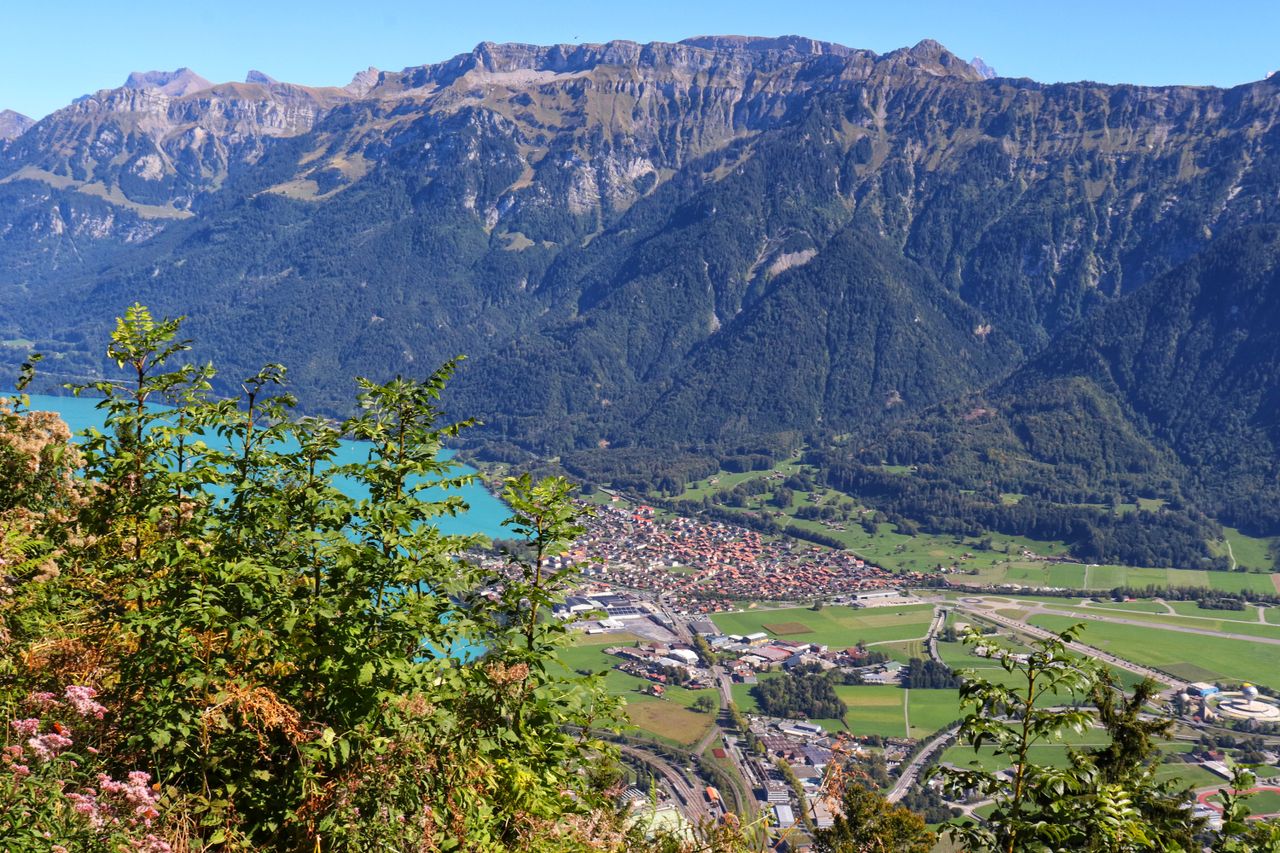
Interlaken seen from the Harder Kulm viewpoint
Town · Viewpoint

Interlaken & Harder Kulm

The funicular from Interlaken Ost climbs in ten minutes to a terrace at 1,322 metres with both lakes below and the three peaks lined up behind. Sunset is the time. In town, the Höhematte meadow is where the paragliders land.

Harder Kulm in detail →
An alpine lake reflecting the surrounding mountains
Lake

Oeschinensee

A turquoise lake walled by the Blüemlisalp at 1,578 metres above Kandersteg, reached by gondola and a 20-minute walk. Rowing boats in summer, a summer toboggan run, and the Heuberg path for the view from above. A UNESCO site and the region's most photographed water.

Oeschinensee in detail →
Seeburg castle at Iseltwald on Lake Brienz
Lake · Boat

Lake Brienz & Giessbach

The milkier, greener of the two lakes. Take the steamer from Interlaken Ost to the Giessbach falls, where a funicular from 1879 climbs to a grand hotel, then on to Iseltwald's castle and Brienz, the woodcarving village under the Rothorn's steam railway.

Lake Brienz and Giessbach in detail →
Spiez on Lake Thun with the Alps behind
Lake · Castle

Lake Thun & Spiez

Castles ring the bigger lake: Spiez, above its vineyard and bay; Oberhofen, with its feet in the water; Thun's own, above a medieval town with raised pavements. The boat from Thun to Interlaken West is the slow, right way to arrive.

Lake Thun and Spiez in detail →
The Minster rising above the roofs of Bern
City · UNESCO

Bern

Fifty minutes by train. The old town sits in a loop of the Aare under six kilometres of arcades, with the Zytglogge clock tower, the Minster's spire, the bear park and, in summer, locals floating down the river to the Marzili baths. A full day, and a good one.

Bern in detail →
Hikes & nature

The best walks in the Alps

The lifts do the climbing, so most Oberland hikes are high traverses with the hard work already done. Trails are signposted in yellow with times, not distances; a red-and-white blaze means a mountain path with some exposure.

JFMAMJJASOND

Hiking season: teal = high trails snow-free, green = lower trails and shoulder weeks, grey = winter (snowshoe and valley walks only).

A still lake with a snow-covered mountain range behind
Easy

First to Bachalpsee

The walk everyone can do and nobody regrets. From the First gondola station a broad path contours north-west for 50 minutes to the Bachalpsee, two linked tarns at 2,265 metres that hold the Schreckhorn and Finsteraarhorn upside down on a still morning. Continue ten minutes up the moraine for the view back over the lake to the Eiger.

6 kmreturn
2–2.5 hwalking
150 mascent

Arrive on the first gondola for reflections before the wind rises. The Cliff Walk at First is a five-minute add-on on the way back.

Full route guide →
A scenic view across the Swiss Alps
Easy

Männlichen to Kleine Scheidegg (Panorama Trail)

From the Männlichen cable-car top station, walk ten minutes to the Royal Walk summit for the full line-up, then follow the wide, almost level trail along the ridge toward Kleine Scheidegg with the Eiger north face growing in front of you the whole way. Trains run down from Kleine Scheidegg to both Grindelwald and Wengen.

4.6 kmone way
1.5 hwalking
200 mdescent

Pushchair-friendly and busy by noon. Go up from Grindelwald Grund on the Eiger Express for the fastest approach.

Full route guide →
Snow-capped mountains under a clear sky
Moderate

Eiger Trail

Directly beneath the north face. From Eigergletscher station, above Kleine Scheidegg, the path crosses scree and alpine meadow under 1,800 metres of limestone and ice, past the spots where the 1930s climbs began, then drops to Alpiglen for the train back to Grindelwald. Loud with meltwater in June, golden with grass in September.

6 kmone way
2.5–3 hwalking
760 mdescent

Mostly downhill but rocky and exposed in places; poles help. Not for a day with cloud on the face, which is the whole point.

Full route guide →
A path winding through green hills toward a mountain range
Demanding

Schynige Platte to First via the Faulhorn

The Oberland's great ridge walk. The 1893 cog railway from Wilderswil lifts you to Schynige Platte (1,967 m) and its alpine garden; the trail then runs east along the crest above Lake Brienz, past the Sägistalsee, up to the Faulhorn (2,681 m) and its 1830s summit inn, and down over the Bachalpsee to First. Both lakes, all three peaks, and the whole chain from the Titlis to the Wildstrubel.

16.5 kmone way
6–7 hwalking
1,000 mascent

Start on the first train and carry water; there is nothing between the Platte and the Faulhorn. Sleep at the Faulhorn hut for a sunrise most people never see.

Full route guide →
Wooden houses below Swiss mountains
Moderate

Mürren to Gimmelwald and the valley

From Mürren follow the Northface Trail past the farms at Blumental, with the Eiger, Mönch and Jungfrau directly across the gulf, then drop to Gimmelwald, a hamlet of hay barns and one famous hostel, and down the old mule path through the forest to Stechelberg. Add the Allmendhubel funicular for the flower trail and the best playground in the Alps.

9 kmdescent
3.5 hwalking
750 mdescent

Cable cars run from Stechelberg back up to Mürren if the knees have had enough. Trümmelbach falls are a 20-minute walk down the valley from the bottom.

Full route guide →
The turquoise Oeschinensee lake above Kandersteg
Moderate

Oeschinensee and the Heuberg

From the gondola top station above Kandersteg, walk 20 minutes to the lake, then take the panorama trail up to the Heuberg benches for the view everyone comes for: the turquoise water, the Blüemlisalp glaciers and the waterfalls feeding them. Descend to the lakeside inns for a swim that is colder than it looks.

8 kmloop
3 hwalking
400 mascent

Kandersteg is 50 minutes from Interlaken by train via Spiez. Pair the lake with the Blausee, a tiny spring-fed pool in the forest below, on the way back.

Full route guide →
Easy · 2 h

Lauterbrunnen to Stechelberg

Valley floor

Flat and flower-lined past Staubbach and Trümmelbach to the end of the road, with cliffs on both sides. Bus back.

The valley walk →
Easy · 1 h

Harder Kulm to Lake Brienz

Interlaken

Take the funicular up for sunset and walk down the forest path in the dusk, or do it the other way for the view at the top.

Harder Kulm →
Moderate · 4 h

Wengen to Wengernalp and Kleine Scheidegg

Lauterbrunnen side

The old path up through the meadows under the Jungfrau, the way walkers reached Kleine Scheidegg before the railway. Train down.

Route guide →
Paragliding is the other way to see the valleys: tandem flights launch from Beatenberg above Interlaken and from First, and land on the Höhematte or at Grindelwald. Half an hour in the air, bookable the same day in good weather.
Wildlife

Ibex on the ledges, marmots in the grass

The Oberland's animals live above the tree line and keep early hours. Walk the high trails before nine and you will meet most of them.

Alpine ibex

Schynige Platte, First, Schilthorn ridges · dawn and dusk

Hunted to extinction in Switzerland by the 1800s and reintroduced from Italy, the ibex is now back on the Oberland's crags. Males with metre-long horns graze the ridges above the Faulhorn trail and around the Schynige Platte alpine garden, unbothered by walkers who keep their distance.

JFMAMJJASOND

Marmots

Männlichen, First, Allmendhubel, Oeschinensee · summer

You hear them before you see them: a sharp whistle and a brown shape vanishing into a burrow. The colonies along the Panorama Trail and on the slopes above Bachalpsee are the easiest, fattest and least shy. They sleep from October to April.

JFMAMJJASOND

Chamois and red deer

Forest edges, Kandertal, the Eiger Trail scree

Chamois pick across the scree under the Eiger and the cliffs above Mürren in small groups; red deer bell in the forests of the Kandertal and above Lake Brienz in late September and October.

JFMAMJJASOND

Golden eagles and bearded vultures

High ridges, Schilthorn, Blüemlisalp

Golden eagles hunt marmots along the ridges; the bearded vulture, with a near three-metre wingspan, was reintroduced to the Alps in the 1990s and now cruises the Kandertal and Jungfrau region. Watch the skyline from any summit terrace.

JFMAMJJASOND
An Alpine ibex on a steep hillside
Summer

Ibex

Look up at the rock bands, not the path.

An Alpine ibex on a ridge at sunrise
Dawn

First light on the ridge

Sleep at a mountain inn to see them before the lifts open.

Cows grazing in a green pasture below mountains
Late September

The cows come home

The Alpabzug, when herds descend from the summer alps in flowers and bells, fills the villages for a weekend.

Good food

Cheese, cream and a few serious tables

Mountain food here is built for cold evenings: fondue and raclette from alp cheese, Rösti under everything, meringues drowned in Nidle cream. Grindelwald and Bern add the region's serious kitchens.

Bread dipped into a pot of cheese fondue
Eat this

Fondue and raclette

The Oberland pot is moitié-moitié, half Gruyère and half Vacherin, with kirsch and a crust at the bottom called la religieuse that you scrape and share. Raclette is the same cheese melted onto potatoes with pickles. Order it in a wood-panelled Stübli, never on a terrace.

A brown Swiss cow in a mountain pasture
Eat this

Alpkäse and the mountain inns

Cheese made on the summer alps from the milk of cows you walked past, sold from the farm door with a bell on it. The Berghaus inns at Männlichen, First, Faulhorn and Schynige Platte serve it with Rösti, Älplermagronen (alpine macaroni with apple sauce) and a view that does the rest.

A pot of stew with drinks and food on a table
Eat this

Meringues, lake fish, Bärner Platte

Meiringen, up the valley from Brienz, claims the meringue; eat it with thick Nidle cream. Lake Thun and Brienz give whitefish (Felchen) and perch for the shore restaurants. In Bern, the Bärner Platte is a mountain of smoked pork, sausage, beans and sauerkraut for a cold day.

Fine dining

Under the Eiger

1910 Gourmet by Hausers

Hotel Schweizerhof, Grindelwald · dinner, booking essential

The Oberland's best room, in a 1910 chalet hotel with the Eiger north face in the window. Alpine produce in a long tasting menu: lake char, Simmental beef, alp cheese courses, mountain herbs. The wine list leans Swiss, which is the point.

CHF 180–260 · $$$$
Bern old town

Wein & Sein

Münstergasse, Bern old town · dinner

A vaulted cellar under the arcades, a short seasonal menu that changes with the market, and one of the best Swiss wine lists in the country. The reason to stay in Bern for dinner.

CHF 150–220 · $$$
Bern

ZOE

Bern, Länggasse · dinner

A small, personal kitchen a short tram ride from the old town, with a surprise menu built around vegetables and whole animals, and a quieter dining room than its reputation suggests.

CHF 160–230 · $$$$

Bib Gourmand

Bib Gourmand

Salzano

Interlaken, Hotel Salzano · dinner

Modern Italian cooking in a boutique hotel on the Aare side of town: handmade pasta, grilled fish, a short list of Ticino and Piedmont wines. The best value in Interlaken and the only Bib between the lakes.

CHF 60–110 · $$

Where locals eat

Chalet classic

Bebbis

Grindelwald, main street · dinner

Fondue in every form, Rösti, veal in cream, served by staff in tracht in a timber barn hung with cowbells. Unashamedly traditional and usually full; book.

CHF 40–70 · $$
Lake table

Les Cascades, Grandhotel Giessbach

Lake Brienz, by boat and funicular · lunch and dinner

A terrace above the Giessbach falls on a hotel that opened in 1875, serving lake fish and classic dishes with the water below. Take the steamer out and the last boat back.

CHF 50–100 · $$$
Mountain inn

Berghotel Faulhorn

2,681 m, on the Schynige Platte–First trail · summer only

One of the oldest mountain inns in the Alps, open since 1830, with soup, Rösti and a bunk for the night. The sunrise over both lakes is the reward.

CHF 20–45 · $
Town favourite

Brasserie 17

Interlaken, Hotel Interlaken · lunch to late

Burgers, Rösti, local beers on tap and a courtyard, in a hotel that has fed travellers since the 1800s. Where the town itself eats.

CHF 25–50 · $$
Drink

Spiez wine and Rugenbräu

Lake Thun and Interlaken

The Oberland's own wine grows on the sunny slope below Spiez castle: a small Riesling-Sylvaner and Pinot Noir that the Rebbau Spiez cooperative sells at the castle cellar. Rugenbräu, brewed above Interlaken since 1866, is the beer at every table.

CHF 6–14 a glass · $
Evenings

Après-ski and mountain quiet

This is a region that goes to bed early, because the first gondola is at eight. Interlaken has the bars, Grindelwald has the après-ski, and the villages on the cliffs have the stars.

Grindelwald

Espresso Bar, Hotel Spinne & Avocado Bar

Grindelwald village · late afternoon to late

The Espresso Bar is the village's après-ski room, loud by four in winter and full of guides in summer; the Avocado, up the street, does cocktails and DJs on weekends. The Bus Stop bar is the late one.

Interlaken

Hüsi Bierhaus & Balmers Metro Bar

Interlaken town and Matten · evenings

Hüsi pours Swiss craft beer and plays live music on the main street; the Metro Bar, in a nuclear bunker under the Balmers hostel, is the only real club between the lakes and runs until the early hours.

Thun and Bern

Thun's riverside and Bern's cellars

30–50 minutes by train · evenings

Thun has summer terraces along the Aare; Bern has the real nightlife of the canton, from cellar bars under the arcades to the Reitschule's concerts and the Dampfzentrale on the river.

Mürren and Wengen

A drink and the dark

Car-free villages · evenings

One or two hotel bars each, a Stübli with a fire, and then a walk out to the edge of the village where the valley drops away and the sky over the Jungfrau does the entertaining.

Practical notes

Before you go

Getting there

Trains from Zürich airport reach Interlaken Ost in about two hours, from Geneva in under three, via Bern. From Interlaken, the Berner Oberland-Bahn runs to Grindelwald and Lauterbrunnen in 30–40 minutes. No car is needed; Wengen and Mürren do not allow them.

Passes

Lifts and trains are expensive one by one. The Berner Oberland Pass (3–10 days) covers most trains, boats and cable cars; the Jungfrau Travel Pass covers the Jungfrau railways; the Swiss Travel Pass gives a discount on Jungfraujoch. Do the sums for your plan before buying.

Seasons

  • Jun–Sep: high trails open, long days, busiest in late July and August.
  • Late Sep–Oct: golden larches, cows coming down, quieter paths; some lifts close mid-October.
  • Dec–Mar: skiing and snowshoeing, Jungfraujoch all year.
  • Apr–May: waterfalls at full roar, high trails still under snow.

Where to base

Grindelwald for lifts and life; Lauterbrunnen for the valley and value; Wengen or Mürren for car-free quiet and the best sunsets; Interlaken for day trips in every direction and the only nightlife.

Mountain sense

Check webcams before paying for a summit on a cloudy day. Weather changes fast; carry a shell and a layer even in August. Trail times on the yellow signs assume a steady walker. Mountain inns need booking in summer and cash is still welcome.

Costs

Switzerland is expensive and the Oberland is no exception: expect CHF 25–40 for a main course, CHF 60–80 for a Jungfraujoch return from Grindelwald with a pass, more without. Supermarket picnics from Coop and Migros are the local way to keep a hiking week affordable.

Photography

Photo credits

Photographs on this page are by independent photographers published on Pexels under the free Pexels licence. Click a title to open the original.

Powered by Webloyt | Report abuse