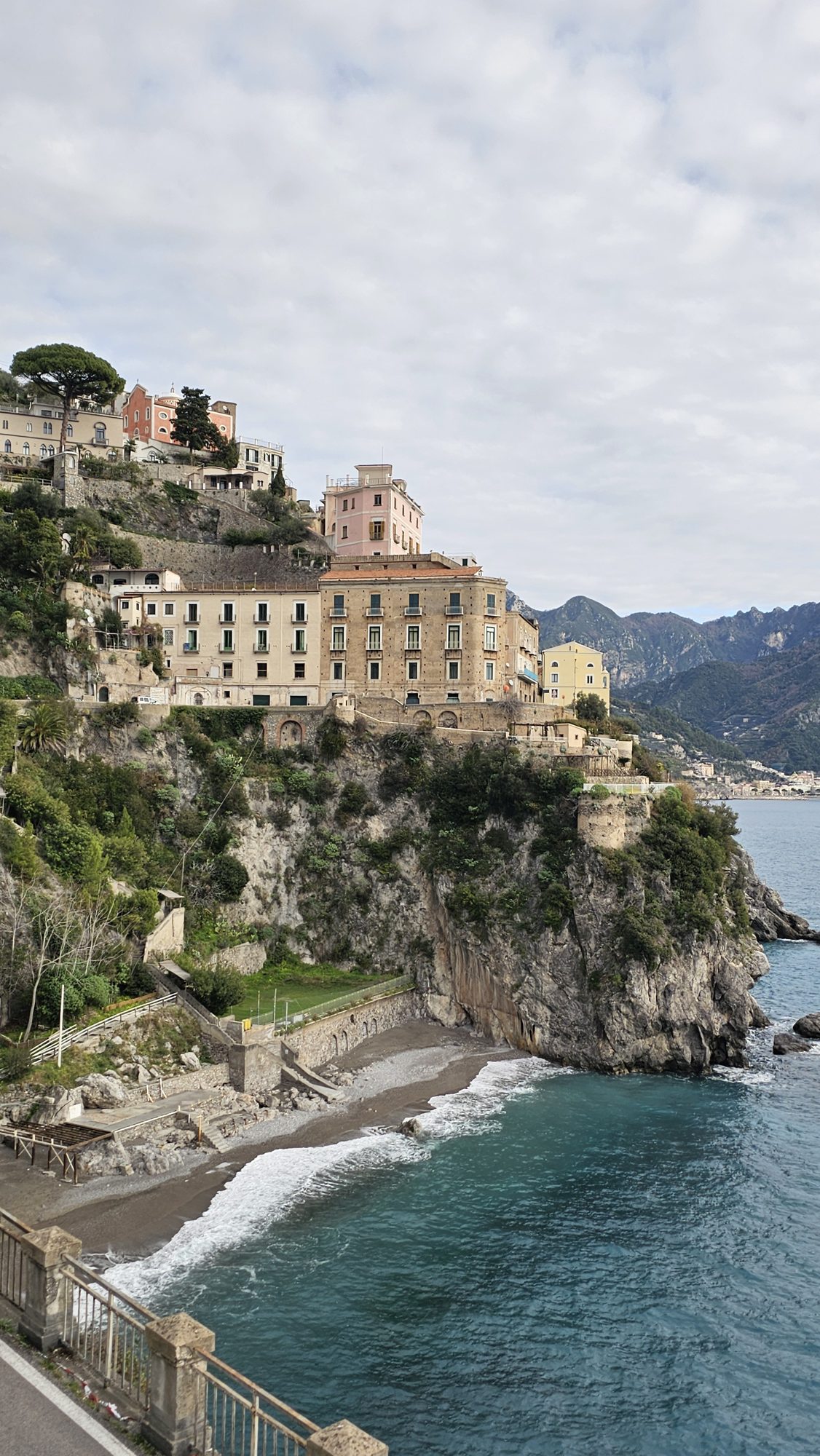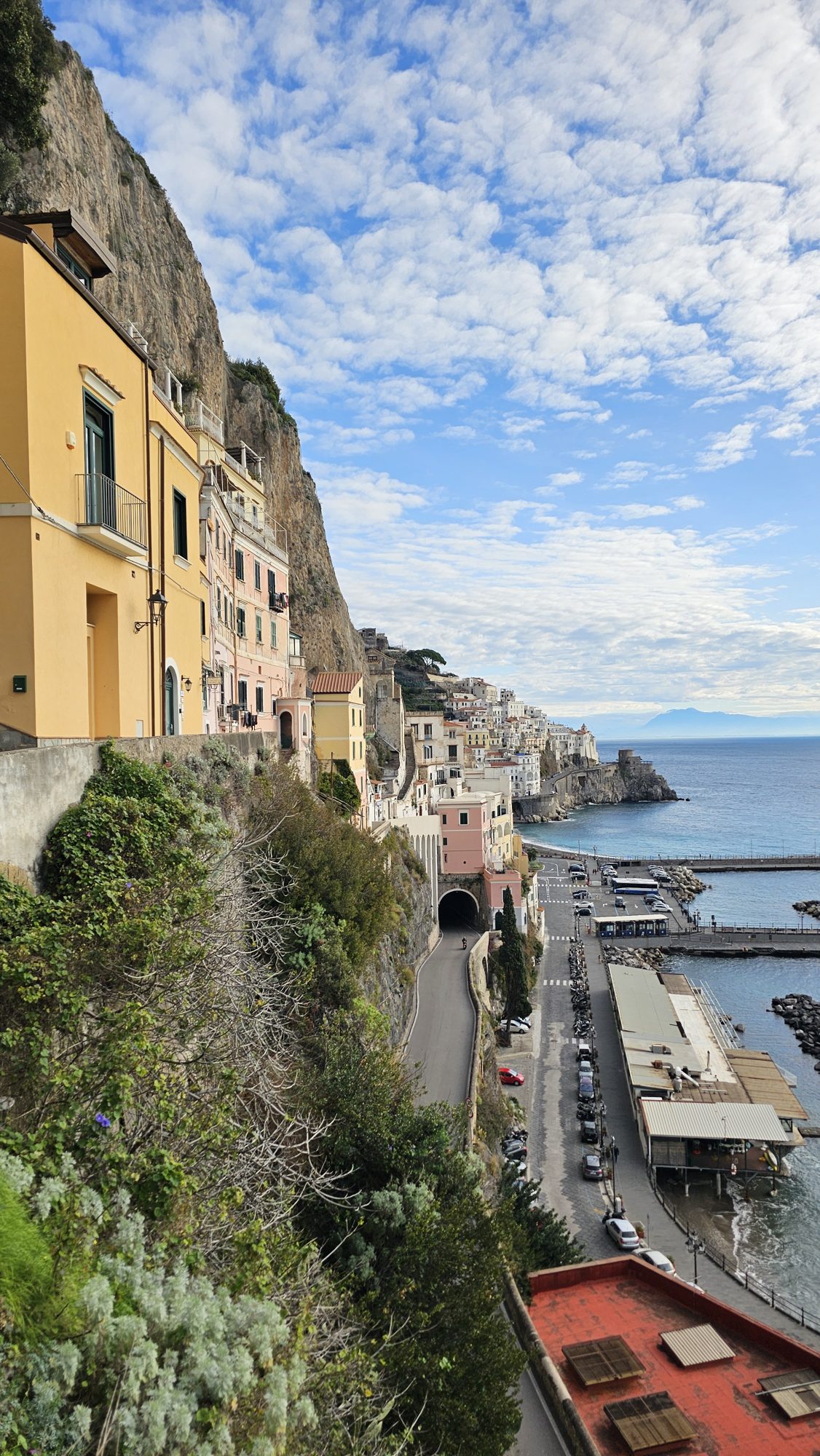
The capital of a medieval sea republic, now a town of 5,000 around one piazza and one great staircase. Every bus and boat on the coast stops here, which makes it the practical base, and a crush at midday.
A thousand years ago Amalfi traded with Constantinople and the Arab world and gave the Mediterranean its first maritime code. The money built a cathedral that still dominates the town.
Sixty steps lead up from the Piazza del Duomo to the Duomo of Sant'Andrea, with its Arab-Norman striped façade and a bronze door cast in Constantinople. One ticket of a few euros covers the Cloister of Paradise, built in 1268 as a burial ground for the town's nobles, the museum in the old basilica, and the crypt where the relics of the apostle Andrew lie.
Behind the piazza, the main street climbs the ravine into the Valle dei Mulini, the valley of mills. A 13th-century mill is now the Paper Museum, where bambagina paper is still made by hand, and beyond it the path continues into the Valle delle Ferriere, the coast's coolest walk.
Come early or late. In the middle of the day the cruise and coach groups fill the piazza; by evening it belongs to the people who live here.
A half-day walk up the ravine, best started at 8am.
Start where the ferries and buses arrive, then pass through the Porta della Marina into the town.
The fountain of Sant'Andrea and the great staircase; get a coffee before the crowds.
Enter through the Cloister of Paradise, then see the old basilica and the crypt of Sant'Andrea.
Follow the main street uphill to the mill where paper is still made by hand.
Continue past ruined mills into the start of the Valle delle Ferriere, or turn back for lunch.


The SITA buses from Sorrento, Positano, Ravello and Salerno all terminate at the harbour, and ferries run from April to early November.
Convenient for everything, but noisy and busy. Atrani next door or Ravello above are calmer alternatives.
Visit the Duomo first thing, then head up the valley as the day trippers arrive.
Amalfi Coast practical notes →Some photographs are our own; others are from Wikimedia Commons and Pexels under their licences.