The Samuel Beckett Bridge and the Dublin skyline reflected in the Liffey at twilight
Ireland · The Liffey and the bay

Dublin

A small capital on a wide bay, where a medieval book, a Georgian square and a pint poured slowly are the main events, and a thirty-minute train puts you on a cliff path with seals below. Dublin is for walking, talking and the early train to the hills, and for the pub at the end of all three.

Photo: Selim Karadayı via Pexels
Overview

A city you can cross on foot, with the sea and the hills at the end of the line

Dublin was a Viking port, a Georgian showpiece, the second city of an empire and, since 1922, the capital of a small country that punches far above its weight in words and music. The centre is compact: Trinity College, the castle, the two cathedrals, the Georgian squares and the river walks fit inside a thirty-minute stroll, with the Guinness brewery and Kilmainham's prison a little further west. It is a city of talk more than of monuments, and the best of it happens in pubs that have not changed in a century, at a trad session, over a plate of oysters in Howth.

What makes it a walking destination is the DART, the coastal train that runs the length of Dublin Bay. Thirty minutes north is Howth, a fishing harbour with a cliff loop and seals; thirty minutes south are Dún Laoghaire's piers, the Forty Foot swimming hole and Dalkey's island of goats and seals. An hour further, the Wicklow Mountains begin, with Glendalough's lakes and monastic round tower reached by a single daily bus. The city itself is expensive for beds and for pints in the wrong places, and this guide says where the right places are.

Two days covers Trinity, Kilmainham, the museums, a pub crawl and a session. Three adds Howth or the Dalkey coast and a swim. Five lets you take the bus to Glendalough, climb a Dublin mountain and come back for a tasting menu, a whiskey tour and a last pint in the Gravediggers.

The Liffey and the Ha'penny Bridge with the buildings of central Dublin along the quays
The centreTrinity and the Book of Kells, Dublin Castle and the Chester Beatty, the cathedrals, Grafton Street and the Georgian squares, all within a short walk.
West along the riverThe Guinness Storehouse, the whiskey distilleries of the Liberties and Smithfield, Kilmainham Gaol and the deer of Phoenix Park.
The bay by DARTHowth and its cliffs to the north; Dún Laoghaire, the Forty Foot, Dalkey and Killiney Hill to the south.
The hillsThree Rock and the Hellfire Club above the suburbs; Glendalough, the Sugar Loaf and the Wicklow Way an hour out.
Highlights

What to see first

Nine places, four of them reached by train. Dublin's paid sights sell timed tickets that go weeks ahead in summer; the national museums are free and never full. Prices are 2026 adult rates.

The barrel-vaulted Long Room of Trinity College's Old Library, lined with books
About €25 · Timed ticket · Old Library closes end 2027

Trinity College and the Book of Kells

The ninth-century gospel book, painted by monks on Iona and brought to Kells for safety from the Vikings, is shown a page at a time under glass; the Long Room above it, sixty-five metres of oak and 200,000 old books, is the picture everyone takes. Tickets are timed and priced by slot, from about €21.50 early on a weekday to €25 or more at the busy hours, and the Experience adds a digital show in a pavilion on the square. The Old Library closes for a long restoration at the end of 2027, with the Book of Kells staying on view, and some shelves are already being emptied. Go at opening.

A pint of dark stout on a table seen from above
From about €26 · Pint included · Book a slot

The Guinness Storehouse

Seven floors of an old fermentation house at St James's Gate telling the story of the brewery Arthur Guinness leased in 1759 for nine thousand years, ending with a pint, included in the ticket, in the Gravity Bar with the whole city below the glass. Prices move with the time of day, cheapest on a weekday morning, and the Connoisseur tastings cost extra. It is the most visited attraction in Ireland and knows it, but the view and the pint are real. The Liberties distilleries are ten minutes away for the afternoon.

An iron staircase and galleries inside an old stone prison
€8 · Guided tour only · Released 28 days ahead

Kilmainham Gaol

The prison where the leaders of the 1916 Rising were shot in the stonebreakers' yard, and where every generation of Irish rebels from 1798 to the Civil War was held, told on an hour's guided tour through the Victorian east wing and the dank old cells. Tickets are sold only on the museum's own site, at midnight Irish time twenty-eight days ahead, with a few same-day tickets released online at a quarter past nine; resold tickets are refused at the door. Summer dates go in minutes. Pair it with the Irish Museum of Modern Art next door and a walk back through the park.

The Bedford Tower and the clock in the courtyard of Dublin Castle
Free · Closed Monday in winter at the Chester Beatty

The castle, the Chester Beatty and the free museums

Dublin Castle's courtyards and gardens are free and its State Apartments a few euros; behind it the Chester Beatty holds one of the finest collections of manuscripts in the world, Qurans, Japanese scrolls, early Christian papyri, for nothing. On Kildare Street the National Museum shows the bog bodies, the Ardagh Chalice and the Tara Brooch, and round the corner the National Gallery has Caravaggio's lost Taking of Christ and the Yeats room, both free. The Natural History Museum and the Hugh Lane are closed for rebuilding, the latter until about 2028.

Walkers on a grassy clifftop path above the sea at Howth
DART, 30 min · Free · Cliff loops of 6 to 12 km

Howth

A fishing harbour at the end of the northern DART line with seals waiting by the fish stalls, a weekend market, the best seafood lunches in the county and, from the station, the cliff path round Howth Head past the Baily lighthouse: six kilometres for the short loop, twelve for the Bog of Frogs over the summit. Boats cross to Ireland's Eye, with its gannets and a few puffins, from April to September. Details in the walks and wildlife sections.

A pale fallow deer stag standing in autumn parkland
Free · 700 hectares · Zoo €22.50 online

Phoenix Park

One of the largest walled parks in Europe, twice the size of Central Park, with a herd of five or six hundred fallow deer descended from the 1660s, the President's house, which opens free on Saturdays, the Papal Cross, the Wellington obelisk and Dublin Zoo. Hire a bike at the gate and ride the length of it; the deer are usually round the Fifteen Acres, and in October and November the bucks are rutting and best watched from fifty metres.

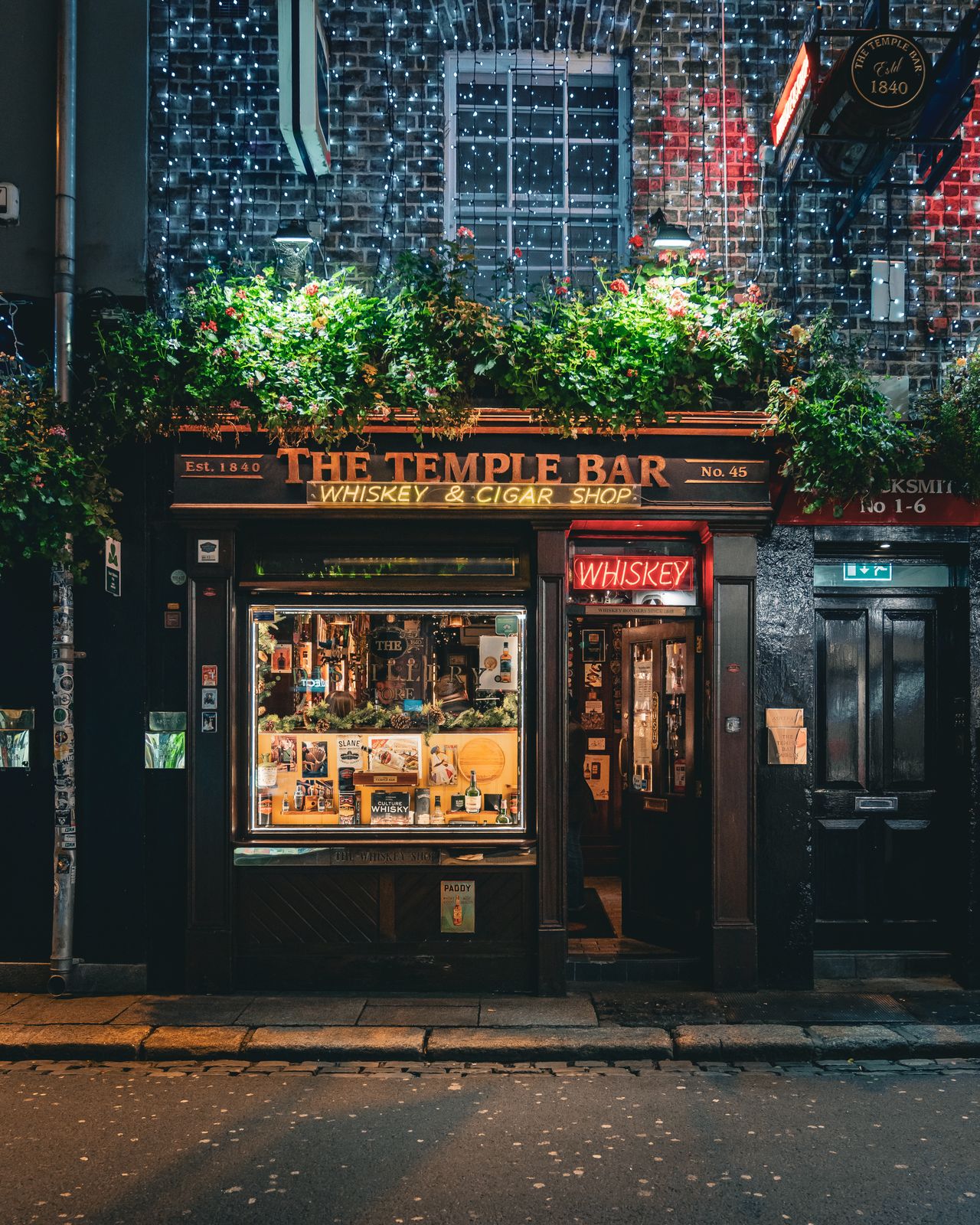
The red-painted frontage of the Temple Bar pub lit up at night
Walk through · Drink elsewhere · Saturday food market

Temple Bar

The cobbled quarter between Dame Street and the river is lively, photogenic and the most expensive place in Ireland to drink: a pint of Guinness in the famous red pub costs €9 to €11, while a better one five minutes' walk away costs under €7. Walk it for the lanes, Meeting House Square's Saturday food market, the Irish Film Institute and the Project Arts Centre, then take your thirst to the pubs in the nightlife section. Weekends bring the stag parties.

A stone wall curving along the Dublin coast above the Irish Sea
DART, 25 min · Free · Swim, walk, lunch

Dún Laoghaire, the Forty Foot and Dalkey

The southern line runs along the bay to Dún Laoghaire's two granite piers, Sandycove's Martello tower where Ulysses opens, the Forty Foot, where Dubliners have swum in the sea every day of the year for two centuries, and on to Dalkey, a village of castles, good restaurants and the walk up Killiney Hill to the obelisk and the view that Dubliners compare, without irony, to the Bay of Naples. Kayaks go out to Dalkey Island's seals and goats from Coliemore Harbour.

Lough Tay in the Wicklow Mountains, a dark lake below heather slopes
Bus 11am from St Stephen's Green · €23 return, cash

Glendalough and the Wicklow Mountains

An hour south of the city a sixth-century monastery sits between two lakes in a glacial valley, with its round tower, its stone churches and the Spinc boardwalk climbing above the Upper Lake. The Wicklow Mountains National Park around it is heather, bog and granite, with sika deer and red kites. St Kevin's Bus leaves the north side of St Stephen's Green once a day at eleven, cash only, and comes back in the late afternoon; coach tours are the alternative. Details in the walks section.

Also worth your time

St Patrick's €11.50 · Christ Church paid

The two cathedrals

St Patrick's, Jonathan Swift's church; Christ Church, with its medieval crypt

Both Church of Ireland, both medieval under Victorian restoration, both charging. St Patrick's for Swift's grave and the choir at Evensong, Christ Church for the crypt, the mummified cat and rat, and the bridge across to Dublinia's Viking museum.

€22 · Docklands

EPIC, the emigration museum

CHQ building by the Liffey · 90 minutes · open late some evenings

Interactive galleries in the old tobacco vaults on why ten million people left Ireland and what they did next. Good on a wet afternoon, and the Docklands outside have the Jeanie Johnston famine ship and the Beckett bridge for the walk back.

€18 · Tour and museum

Croke Park and the GAA Museum

Drumcondra · tours at 11, 1 and 3 · closed on match days

The 82,000-seat home of hurling and Gaelic football, amateur sports played at professional intensity; the tour goes to the dressing rooms and the pitch, and the Skyline walk, €24, along the roof. From April to July the championship fills it on Sundays; final tickets are near impossible, early rounds are not.

Tours €20–41

The whiskey distilleries

Teeling in the Liberties; Jameson at Bow Street, Smithfield

Dublin made the world's whiskey in the nineteenth century, lost it in the twentieth and is distilling again. Teeling is a working distillery with tastings from €20; Jameson's Bow Street is a polished visitor experience from €26. Both in the whiskey section below.

Walks & nature

Cliff loops by train, a monastery between two lakes and the mountains at the end of the bus

Dublin is the only European capital with a mountain range inside the county boundary and a cliff walk on the suburban train. None of it needs more than a day, a waterproof and a sandwich, and most of it ends at a harbour with a pub.

JFMAMJJASOND

Walking season: teal = May to September, long days and the driest months, with seventeen hours of light in June; green = the shoulders, often the clearest skies of the year in April and October but short on daylight at the edges; grey = November to February, seven or eight hours of light, mud on the hills and the sea at its coldest. It can rain lightly in any month; it rarely rains all day.

A cliff edge above a bay on the Irish coast
Moderate · 6, 8 or 12 km · DART from the centre

The Howth cliff path

Three waymarked loops leave Howth DART station and climb onto the headland. The short Cliff Path Loop, six kilometres, follows the edge above the Nose of Howth to the Baily lighthouse viewpoint and returns through the village in about two hours; the eight-kilometre Black Linn loop climbs higher; the Bog of Frogs, twelve kilometres and three and a half to four hours, takes in the summit, the heather of the inland bog and the whole circuit of the head, with Dublin Bay, the Wicklow Mountains, Ireland's Eye and Lambay all in view on a clear day. The path is narrow and unfenced in places and muddy after rain; wear proper shoes and keep children close at the edges.

6–12 kmthree signed loops
2–4 hdepending on loop
170 mthe summit

Finish at the harbour: seals by the fish stalls on the West Pier, oysters or chowder at the pier restaurants, the Saturday and Sunday market by the station. Trains run every ten to twenty minutes back to the city.

A green grassy hill under a wide sky
Moderate · 9 km · The Spinc, White Route

Glendalough: the Spinc and the Glenealo valley

From the Upper Lake car park the White Route climbs past the Poulanass waterfall on a long wooden boardwalk to the Spinc, the ridge that runs the whole length of the Upper Lake four hundred metres above the water, with the glacial valley, the two lakes and the round tower laid out below. At the head of the valley it drops into the Glenealo, past the ruins of the nineteenth-century lead mines, and follows the river back along the shore to the monastic city of St Kevin, with its round tower, cathedral and the tiny church they call Kevin's Kitchen. Three to four hours; shorter green and purple routes stay on the valley floor.

9 kmloop
3–4 hplus the monastery
380 mof climbing

St Kevin's Bus leaves the north side of St Stephen's Green at eleven and returns in the late afternoon, €14 single and €23 return, cash only, which leaves about four hours in the valley; the half-day coach tours give less. Sika deer graze the upper valley at dusk and peregrines nest on the cliffs.

A lighthouse at the end of a breakwater at sunset
Easy · 8 km return · Flat and exposed

The Great South Wall to Poolbeg lighthouse

The strangest walk in Dublin and one of the best: from Ringsend, past the twin red-and-white chimneys of the old power station, out along the eighteenth-century granite breakwater that runs four kilometres into the bay to the red Poolbeg lighthouse. Ferries pass close enough to wave at, Howth and the Wicklow hills bracket the view, and at sunset the whole bay turns copper. Nothing to climb and nowhere to hide from the wind; in a storm the waves come over the wall and the walk is closed by common sense.

8 kmthere and back
2 hat a stroll
0 mof climbing

Take the bus or a bike to Ringsend and walk out along Pigeon House Road, or begin at Sandymount Strand and add the beach. Sunset in summer, when the light goes on past ten, is the time.

Moderate · 2–3 h · Bus or taxi

Three Rock, Fairy Castle and the Hellfire Club

The Dublin Mountains above Rathfarnham and Sandyford

From the Ticknock car park a forest road climbs to the masts on Three Rock and the cairn on Fairy Castle at 536 metres, the city and the bay spread below. On the next hill west the ruined Hellfire Club, a 1720s hunting lodge with a bad reputation, is an hour's loop from the Montpelier car park through Massy's Wood.

Easy · 1 h · DART to Dalkey

Killiney Hill and Dalkey

From Dalkey village or Killiney station

A short climb through the park to the obelisk, with Killiney Bay, the Sugar Loaf and the Wicklow coast to the south and the whole of Dublin Bay to the north. Down the other side to the Vico Road, the baths and Dalkey's pubs.

Easy · 10 km · Bus to Clontarf

Bull Island and Dollymount Strand

Dublin Bay Biosphere · wooden bridge or causeway from the Clontarf road

Five kilometres of sand, dunes and salt marsh grown up behind a Victorian sea wall, inside the city limits and loud with brent geese from October to April. Walk the beach out and the lagoon side back.

Moderate · 1 h · Bus 184 or car

The Great Sugar Loaf

Kilmacanogue, Co. Wicklow · from the upper car park

The pointed quartzite hill that looks like a volcano from every Dublin vantage point is a short, steep scramble to a 501-metre summit with the sea on one side and the Wicklow uplands on the other. Combine with Bray's seafront and the climb to the cross on Bray Head.

Hard · 21 km · Marlay Park to Knockree

The Wicklow Way, stage one

From Rathfarnham · a full day · taxi or bus back from Enniskerry

Ireland's oldest long-distance trail starts in a Dublin suburb and climbs over Kilmashogue and Fairy Castle into the Glencullen valley: a long day of forest road, open hill and views, ending near Knockree hostel and Enniskerry. Carry food and water and arrange the way back.

Flat · Any length · Bikes

The canals

Grand Canal from the Docklands; Royal Canal from Spencer Dock

Two Georgian canals leave the city westward with towpaths all the way: the Grand Canal past Kavanagh's bench and Portobello to the suburbs, the Royal Canal Greenway for 130 kilometres to the Shannon. Flat, quiet and best on a Dublin Bike.

The Bray to Greystones cliff walk, the famous one, is closed after landslips and is not expected to reopen before 2029; Wicklow County Council's signs mean it. Use the Howth loops for sea cliffs and climb Bray Head from the seafront for the view instead.
Water

A sea-swimming culture, kayaks to an island of seals and a bay for the hardy

Dubliners swim in the Irish Sea every day of the year, and the places they do it are an easy train ride from town. The bay beyond is cold, green and full of life: seals, wrecks and the kelp of Dalkey Sound.

Rocks and breaking waves on the Irish coast
Sea swimming · All yearWarmest August to September

The Forty Foot, the Vico and Seapoint

The Forty Foot at Sandycove is a deep rocky inlet with steps and a diving board, swum by Dubliners since the eighteenth century and by women too since the 1970s, with a famous Christmas morning plunge and a dawn crowd of regulars who talk more than they swim. Down the coast the Vico Baths at Dalkey are wilder, with a railed path down the cliff and no lifeguard; Seapoint at Monkstown is the gentle sandy option with a summer lifeguard. The water is about 8°C in March and 15 or 16°C in late summer, so a swim is a shock in any month and a quick one from October to May. Bring a towel and a hot drink; there is a changing shelter and little else.

Freeall three
8–16°CMarch to September
DARTSandycove, Dalkey, Seapoint
All yeardawn and dusk busiest

Check the council's bathing notices after heavy rain, when storm overflows close some beaches for a day or two. Swim with the regulars, inside the inlet, and respect the current beyond the rocks.

Kayak · 3 h

Seals and Dalkey Island

Coliemore Harbour, Dalkey · wetsuits and kit supplied · ages 16 to 75

Guided sea kayaks paddle the sound to Dalkey Island, where grey seals haul out on the rocks and feral goats graze round the Martello tower, with a landing when the weather allows. Book ahead in summer; the same operator runs kayak tours through the city on the Liffey.

Diving · April to October

Dalkey Sound and the bay

Dive centre at Dún Laoghaire Harbour · drysuit most of the year

Dalkey Island and the Muglins rocks are twenty minutes by boat: kelp walls, seals that come to look, and the deeper wrecks of the bay for experienced divers. Sandycove is the shore dive where Dublin's clubs train. Cold water and a few metres of visibility make it a diver's day out rather than a holiday's purpose.

Paddleboard · Sheltered

Grand Canal Dock and the harbour

Docklands; Dún Laoghaire · hire and lessons in summer

The flat water of the old dock in the Docklands and the inner harbour at Dún Laoghaire are where paddleboards and dinghies go out; both have hire in season. The Liffey Swim, raced through the city since 1920, is late summer's spectacle.

Wildlife

Deer in the park, seals in the harbour, geese from the Arctic and a seabird island

Dublin Bay is a UNESCO biosphere reserve, and its wildlife is easy: a herd of deer inside the city, seals that beg from fish stalls, tens of thousands of wintering geese on the strand and a gannet colony reached by a ten-minute boat.

The fallow deer of Phoenix Park

Around the Fifteen Acres and the Papal Cross · rut October to November, fawns in June

Five to six hundred fallow deer, descended from a herd enclosed in the 1660s, roam the park's grasslands and are usually found in the open south of the main road. The Office of Public Works asks for fifty metres' distance, no feeding, no touching and dogs on leads; in the autumn rut the bucks groan and clash and are not to be approached, and in June the does hide fawns in long grass that must not be disturbed. Dawn or the last hour of light.

JFMAMJJASOND

Brent geese and the birds of the bay

Bull Island, Sandymount, the Tolka estuary · October to April

Light-bellied brent geese arrive from Arctic Canada each October, thousands of them grazing the lagoons of Bull Island and, by midwinter, the playing fields of the city, and leave in April. With them come knot, godwit, curlew and oystercatcher at high tide on the strand. Bull Island's causeway and the sea wall at Clontarf are the places, and winter is the season.

JFMAMJJASOND

Seals, gannets and a few puffins

Howth harbour and Dalkey Island all year; Ireland's Eye boats April to September

Grey and harbour seals lie off Howth's West Pier waiting for scraps from the fish stalls and haul out on Dalkey Island's rocks. Ireland's Eye, the small island off Howth, holds a gannet colony on its sea stack, guillemots, razorbills, kittiwakes and a handful of puffins in spring and early summer; ferries cross from the harbour from April to late September, with landings on weekdays timed around a late-morning crossing and a longer stay at weekends. Lambay, the larger island beyond, has the big puffin colony and wallabies, with landings by arranged tour only.

JFMAMJJASOND

The Wicklow uplands

Glendalough and the mountain roads · deer rut October; kites all year

Sika deer, introduced from Japan in the 1860s, graze the valley above Glendalough's Upper Lake at dusk and whistle eerily in the October rut; red kites, reintroduced from 2007, now hang over the Wicklow roads, and peregrines nest on the cliffs above the lake. In the city itself, foxes are everywhere after dark and herons stand on every stretch of canal.

JFMAMJJASOND
A deer with a fawn on a grassy glade
June

Fawns

Hidden in the long grass. Leave them.

A seal lying on a rock by the shore
Howth and Dalkey

Seals

Fed too well on the West Pier.

Flocks of birds on a flat coastal nature reserve
October to April

Brent geese

Arctic Canada to Clontarf, every year.

Food

Oysters and brown bread, a full Irish, a spice bag and a tasting menu or two

Dublin eats better than its reputation. The raw materials are superb, Dublin Bay prawns, Carlingford oysters, grass-fed beef and butter, and a generation of cooks has built a serious restaurant city on them. The pub lunch and the fry-up are still where most of the pleasure is.

A full Irish breakfast plate with eggs, sausages, bacon, black pudding and beans
Breakfast

The full Irish

Sausages, rashers, eggs, black and white pudding, tomato, beans and a slice of soda bread, with the tea strong enough to stand a spoon in. Every café does one; the good ones use Clonakilty pudding and butcher's sausages. Coddle, the Dublin stew of sausages, bacon and potato boiled pale, is the city's own dish and is better than it sounds when the Gravediggers makes it.

A plate of fresh oysters on ice with lemon
From the bay

Oysters, prawns and chowder

Dublin Bay prawns, which are langoustines and mostly from elsewhere, come grilled with garlic butter at every good fish place; Carlingford and Galway oysters arrive by the dozen with a stout; seafood chowder with brown bread is the lunch on every pier. Howth's harbour restaurants and the fish shops on the West Pier are the place for all three, and the Temple Bar Food Market on Saturdays has the oyster stall.

A plate of fried breakfast with toast and a mug on a café table
Late night

Spice bag, chipper and Tayto

Dublin's contribution to world cuisine is the spice bag, a Chinese takeaway's brown bag of chips, shredded chicken, fried peppers and onions and a shake of five-spice, invented in the suburbs in the 2010s and now a national dish at 1am. Leo Burdock has fried fish and chips by Christ Church since 1913. Tayto cheese and onion crisps in a sandwich of white bread and butter is the pub snack; brown bread ice cream the pudding.

The best tables

Dublin's top kitchens, from the two grandest rooms in the country to a Portobello neighbourhood room, listed by what they are rather than by ranking. Book well ahead for all of them; most take reservations a month or two out and the tasting menus run from about €120 to over €300.

The grand oneMerrion Hotel

Restaurant Patrick Guilbaud

Classical French with Irish produce · since 1981 · lunch is the way in

The country's most decorated dining room for forty years, run with a precision that has not changed: Wicklow lamb, Kilkenny beef, lobster from Castletownbere, the trolley of cheese, the sommelier who knows. The set lunch is a fraction of dinner's price and the same kitchen.

The modern oneParnell Square

Chapter One by Mickael Viljanen

Basement of the Writers Museum · tasting menu · the northside's great room

Finnish-born Viljanen took over the city's best-loved restaurant in 2021 and made it the most exciting: a long, precise, generous tasting menu that moves between Irish produce and French technique with real wit. The pre-theatre menu feeds the Gate across the square.

Blackrock, by DART

Liath

Twenty seats in a suburban market · set menu · a few evenings a week

Damien Grey's tiny room in Blackrock Market, fifteen minutes down the line, serves a single changing menu of a dozen small, intense courses from a counter kitchen. The hardest table in the county to book and worth the two months' notice.

Fitzwilliam Hotel

Glovers Alley

Andy McFadden · first floor over St Stephen's Green · lunch and dinner

Polished, pretty cooking in a bright hotel dining room overlooking the Green: Irish seafood and game dressed with French classicism. The three-course lunch is one of the city's bargains at this level.

Dame Street side

D'Olier Street

Anthony Smith · counter and tables · a shorter menu at lunch

Serious, inventive, often playful tasting menus in a room with none of the hush of the grand places: fermented, smoked and aged Irish ingredients handled with a surgeon's care. A lunch menu makes it affordable.

South Circular Road

Bastible

Neighbourhood room in Portobello · set menu · Wednesday to Saturday

A small, warm restaurant named after a cast-iron pot, where a tasting menu built on Irish vegetables and fish comes with natural wine and no ceremony. The loveliest of the starred rooms to spend an evening in.

Coombe, the Liberties

Variety Jones

Keelan Higgs · open fire · family-style courses

Everything cooked over wood in a narrow Liberties room: lamb, langoustines and whole fish arriving to share. Loud, close and the most fun of the top tables; the counter seats put you at the fire.

Ranelagh

Forest Avenue

John and Sandy Wyer · neighbourhood tasting menu · the 2026 newcomer

A Ranelagh room that has fed its neighbourhood for a decade and was recognised in the 2026 guide: seasonal Irish produce in a long, kind tasting menu with a serious wine list. A ten-minute tram from town.

Best for value

The Bib Gourmand places, where the Michelin inspectors eat when they are paying: good cooking at fair prices. Three were added for 2026; the rest have held their places for years.

Bib Gourmand · new 2026

Bigfan

Aungier Street · Chinese-Irish · bao and skewers

A basement of neon and noise doing the best Chinese cooking in the city: dumplings, crisp aubergine, chilli chicken and cocktails. Loud, late and cheap for what it is.

Bib Gourmand · new 2026

Borgo

Fade Street · Italian · pasta by hand

Southern Italian plates and handmade pasta in a Creative Quarter room that fills from six; the lunch and early menus are the value.

Bib Gourmand · new 2026

Forêt

Ranelagh · French bistro · from the Forest Avenue team

The Wyers' younger, cheaper room down the road from Forest Avenue: steak frites, snails, a good list of French wine by the glass and a proper crème caramel.

Bib Gourmand

Richmond

Portobello · modern Irish · the Tuesday tasting menu

A corner bistro with a short, seasonal menu and a Tuesday-night tasting menu at a price nobody else matches. Book the window.

Bib Gourmand

Uno Mas

Aungier Street · Spanish · Iberico and sherry

Spanish cooking with Irish produce, a long bar for solo eaters, a serious sherry list and the city's best tortilla.

Bib Gourmand

Spitalfields

The Coombe · gastropub · pies and offal

A Liberties pub turned proper restaurant: pies, chops, devilled kidneys and a wine list far better than a pub needs. Sunday lunch is the one.

Bib Gourmand

Amy Austin

Drury Street · wine bar · small plates under a car park

A wine bar in the arches under a multi-storey, with skewers, small plates and a natural list that changes weekly. Good before and after a night out.

Howth

Aqua, King Sitric and Octopussy's

On the harbour · fish at every price

Aqua at the end of the West Pier for a window table and lobster, King Sitric for the old-school fish restaurant with rooms, Octopussy's for seafood tapas and a pint on the pier.

Pub lunch

L. Mulligan Grocer, The Old Spot and The Exchequer

Stoneybatter; Bath Avenue; Exchequer Street

Three pubs that cook properly: Scotch eggs and a huge beer list in Stoneybatter, a serious Sunday roast by the stadium, and gastropub plates in town till late.

Cheap, local and loved

Gallagher's Boxty House

Temple Bar · the Irish classics

Boxty, the potato pancake, wrapped round beef stew or bacon and cabbage; coddle and brown bread. Touristy, honest and the one Temple Bar restaurant worth the price.

The Winding Stair

Ormond Quay · over a bookshop

Bacon and cabbage, smoked fish and Irish cheeses in a first-floor room looking across the Ha'penny Bridge. The lunch deal and a glass of Irish cider.

Coffee and brunch

3fe, Two Pups, Kaph, Brother Hubbard

Dublin's coffee is as good as anywhere in Europe. 3fe on Grand Canal Street started it; Two Pups on Francis Street and Kaph on Drury Street do the best brunch queues.

Eating out, the practical side

Lunch is about €15 to €25 and a pub main €18 to €25. Many restaurants add a service charge of ten to twelve and a half per cent for groups of six or more; otherwise ten per cent is a normal tip and nothing is owed at the bar. Sunday roasts and Monday closures are both common. Book Friday and Saturday dinner a week ahead, the tasting menus a month or more, and Howth on a sunny Sunday by noon.

Nightlife

Victorian pubs, a trad session in a corner, cocktails in a cellar and a club till three

The pub is the point of Dublin, and the best ones are not in Temple Bar. Trad sessions happen most nights somewhere; the cocktail bars are among Europe's best; clubs still close at half past two, which the city is arguing about.

The dark wooden interior of a traditional pub with bottles behind the bar
The classics

Pubs nothing has touched

Kavanagh's, The Gravediggers, by Glasnevin cemetery since 1833, no music, no television, the best pint in Dublin; Mulligan's on Poolbeg Street, Joyce's pub, where the Guinness is still taken seriously; The Long Hall on George's Street, all mirrors and mahogany; Toners on Baggot Street with its snug; The Palace Bar on Fleet Street, the journalists' pub; Grogan's for a toastie and a painting; Neary's and Kehoe's off Grafton Street; The Stag's Head for the Victorian room.

A musician playing a violin in a dimly lit room
Trad

Sessions

The Cobblestone in Smithfield, run by a family of pipers, has music seven nights and is the real thing; O'Donoghue's on Merrion Row is where the Dubliners started; the Brazen Head, which claims 1198, has nightly sessions and a storytelling dinner; Devitt's on Camden Street and the Piper's Corner on Marlborough Street are the locals' choices. Sessions begin around nine, no charge, and the etiquette is to listen when they play and talk when they stop.

A bartender pouring a pint of stout behind a bar
The pint

A note on Guinness

It is poured in two parts with a pause between, it settles, and it costs €6.20 to €7 in a normal pub and up to €11 in the Temple Bar pubs. The Gravediggers, Mulligan's and the Long Hall have the reputations; connoisseurs argue in earnest about pipe length and glass temperature. Pints are measured in Irish pints, 568 millilitres, and a last round is called at half past eleven on weekdays and half past twelve on Fridays and Saturdays.

Cocktails

Bar 1661, the Vintage Cocktail Club and Nine Below

Green Street; Crown Alley; St Stephen's Green

Bar 1661, named for the year Ireland banned poitín, is on the World's 50 Best Bars list for its poitín cocktails and is the one to book. The Vintage Cocktail Club is up an unmarked Temple Bar staircase; Peruke & Periwig on Dawson Street does the wigmaker theme well; Nine Below is the hotel basement with the deep list.

Live music

Whelan's, Vicar Street and the Olympia

Camden Street; Thomas Street; Dame Street

Whelan's is the indie room every Irish band played first; Vicar Street the 1,000-seat venue with the best sound; the 3Olympia the Victorian theatre for touring names; the 3Arena for stadium acts; the National Concert Hall for the orchestra. The Academy and the Button Factory fill in the rest.

Clubs

Index, Pygmalion, Opium and the Workman's

Most close 2:30 to 3am · Thursday to Saturday

Index on Wellington Quay for techno, Pygmalion in Powerscourt for house and the courtyard, Opium on Wexford Street for the big rooms, the Workman's Club on the quays for indie and a late bar, Lost Lane behind Grafton Street for a dance. The law to let clubs open till six has been talked about for years and has not passed.

The Nitelink buses run from College Street and Westmoreland Street on Friday and Saturday nights after midnight for €2.40; taxis are plentiful at the ranks and on the apps but scarce at three. Keep phones in pockets on O'Connell Street and the north quays late; the snatching is by bike and quick.
Whiskey & wine

The city that made the world's whiskey, and a wine-bar scene that arrived with the chefs

In 1880 Dublin distilled most of the whiskey drunk in the world; by 1976 it made none. Four distilleries are open again within a mile of each other, and the wine bars of Portobello and Smithfield have become where Dubliners eat.

JFMAMJJASOND

Distillery tours and wine bars run all year; green means every month works. Winter is when the whiskey makes most sense.

Copper pot stills inside a whiskey distillery
The Liberties · Smithfield · Tours €20–41

The distilleries

Teeling on Newmarket, the first new distillery in the city for 125 years, is the working one: three copper stills, a tour and tasting from €20, with the single pot still and the small-batch rum-cask bottlings to try. Jameson's Bow Street in Smithfield is the brand experience, polished and crowded, from €26 for the tour and tasting and €41 to blend your own. Pearse Lyons in a converted church on James's Street, Roe & Co in the old Guinness power station opposite the Storehouse and the Dublin Liberties on Mill Street round out the mile; the Irish Whiskey Museum on Grafton Street explains it all with a tasting if you cannot get out west.

Glasses and bottles on a dimly lit bar counter
Wine bars

Ely, Piglet, Loose Canon and Frank's

Ely Wine Bar on Ely Place, the original, with a cellar of hundreds and organic beef from the owners' farm; Piglet in Temple Bar's Cow's Lane for Italian plates and an Italian list; Loose Canon on Drury Street for Irish cheese and natural wine standing up; Frank's on Camden Street, Note on Cathedral Street and the Fish Shop in Smithfield for the newer, cooler end of it. A good glass is €9 to €14; corkage at the bottle shops that serve is the cheap way in.

Craft beer

Rascals in Inchicore; the Porterhouse; Hope in Howth

Rascals brew and serve pizza by the Luas in Inchicore; the Porterhouse in Temple Bar was the city's first brewpub and still does an oyster stout; Hope Beer's Howth taproom is the end of the cliff walk.

The whiskey bar

The Palace Bar's upstairs; the Dingle Whiskey Bar; L. Mulligan Grocer

The Palace keeps its own bottlings upstairs; the Dingle Whiskey Bar on Nassau Street has 200 Irish labels; Mulligan's in Stoneybatter pours flights with the food. Ask for pot still, the Irish style the world forgot.

What to bring home

Celtic Whiskey Shop, Dawson Street

Redbreast 12, Green Spot, Teeling Single Pot Still, a Powers John's Lane; the Celtic Whiskey Shop will pack it. Allowances are a litre of spirits per adult leaving for most countries.

Practical

Getting there, getting around and getting it right

Dublin is easy and expensive. Beds are the budget-breaker; transport, museums and the sea are cheap. Book accommodation, Kilmainham and the tasting menus early, and everything else can wait.

Arriving

Dublin Airport is ten kilometres north of the city with no rail link; the MetroLink is a decade away. The Aircoach and Dublin Express coaches run every ten to fifteen minutes to the centre for about €9, the 16 and 41 Dublin Bus routes for €2 on a Leap card, and a taxi costs €25 to €40. Ireland is in the EU but not in Schengen, so there is passport control from the continent; the Common Travel Area means no checks from the UK. ETIAS does not apply to Ireland.

Getting around

Buy a Leap card or tap a contactless card: a ninety-minute fare is €2 across bus, Luas tram and DART, capped at €6 a day and €24 a week. The DART runs along the bay from Howth and Malahide in the north to Bray and Greystones in the south every ten to twenty minutes; the Luas has two lines; buses go everywhere else. Dublin Bikes cost €5 for three days. The centre is small enough to walk.

Money and manners

Euro, cards everywhere including the pubs, cash for St Kevin's Bus and the odd market stall. Tip ten per cent at restaurants if no service charge is added, nothing at the bar, round up a taxi. Plug sockets are the British type G. Shops open on Sundays; pubs serve until half past eleven on weekdays, half past twelve on Fridays and Saturdays and eleven on Sundays, with late licences in the city.

Where to stay

Hotels are among the most expensive in Europe, €200 and up in summer for a plain room, so book early or look at Portobello, Stoneybatter and Smithfield for apartments and guesthouses within walking distance. The Docklands have the newest hotels, Ballsbridge the grand ones, Howth and Dún Laoghaire a seaside room with a train to town. Avoid the north inner city around Gardiner Street late at night rather than for the price.

Weather and what to pack

Mild, wet and windy: July averages 19°C by day, January 8°C, and it rains lightly on about half the days in every month without ever raining all day. A waterproof shell, layers, shoes that take mud and a swimming towel. Sunglasses in June, when it is light until ten; a torch is not needed because nowhere is dark.

Safety

A safe city with a few corners: O'Connell Street, Talbot Street and the north quays can be rough late at night, and phone snatching from bicycles is the current nuisance across the centre. Keep the phone away on the street, use the taxi ranks at night and stay with the crowd on the way home. Emergency numbers are 112 and 999.

Dates for the calendar

New Year's Festival from 30 December to 1 January; the St Patrick's Festival, five days round the 17th of March with the parade on the day, when beds triple; Bloomsday on 16 June for Ulysses in Edwardian dress; the Dublin Horse Show in August; Culture Night in September when everything opens free; the Theatre Festival in October; the Christmas market at Smithfield from late November. The GAA championship fills Croke Park on summer Sundays. The 2027 bank holidays include St Brigid's Day on 1 February, Easter Monday, the first Mondays of May, June and August and the last of October.

Booking the hard tickets

Kilmainham Gaol: the official site only, at midnight Irish time twenty-eight days ahead, or the same-day release at a quarter past nine. Book of Kells: timed slots, cheapest first thing on weekdays. Guinness Storehouse: cheaper on weekday mornings. Liath and Chapter One: two months out. Croke Park finals: forget it, go to a Leinster semi-final instead. Ireland's Eye boats and the Dalkey kayaks: a few days ahead in summer.

Credits

Photographs

All photographs on this page are from Pexels and used under the Pexels licence. Thank you to the photographers.

Powered by Webloyt | Report abuse